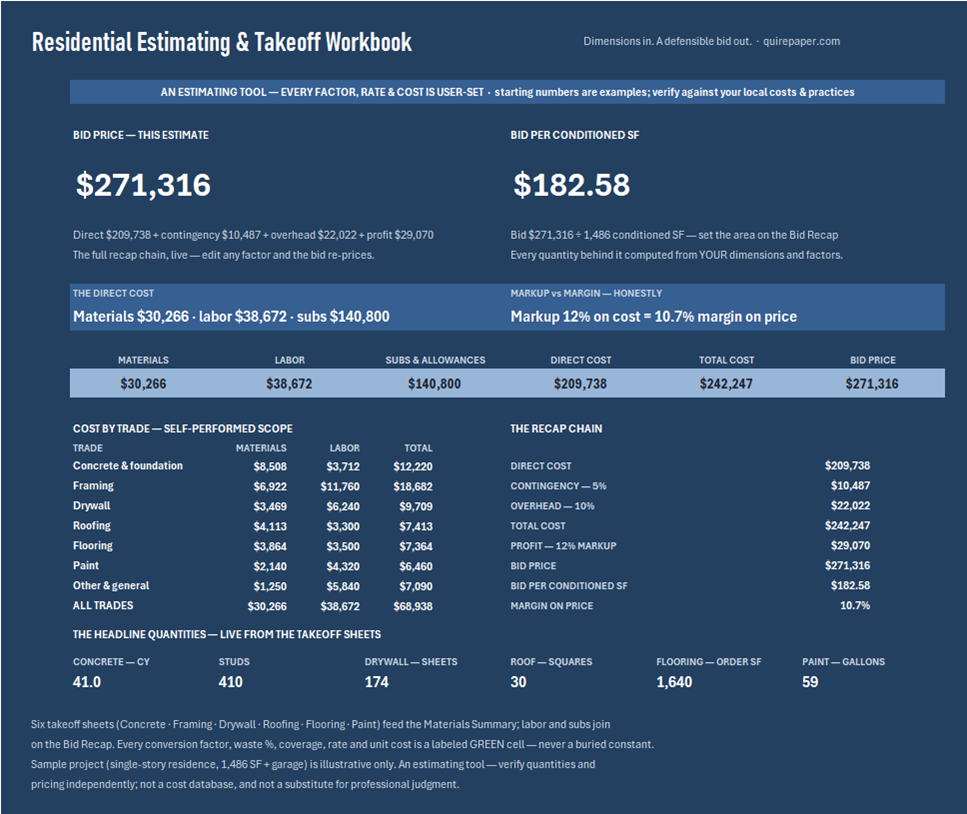
Most estimating templates are a list of cost categories with a sum at the bottom — fine until someone asks where the number came from. This workbook is the other kind: a quantities-first estimate in the shape estimators actually defend. Six takeoff sheets turn plan dimensions into material quantities through formulas you can read out loud: footing LF × section ÷ 27 = CY, with your waste factor and a half-yard round-up; wall LF × 12 ÷ your stud spacing, plus the corner and opening studs you count yourself; drywall SF to sheets, mud, tape and screws at your coverages; plan area × pitch factor to squares and bundles; flooring and paint the same way. The Materials Summary prices every quantity at unit costs you enter, labor runs at your crew hours and burdened rates, and the Bid Recap stacks materials + labor + subs, then contingency, overhead and profit markup — your percentages — into a bid price, cost per conditioned SF, and the margin-on-price the markup actually produces. Change stud spacing from 16" to 24" o.c. and every stud count, the framing materials, the direct cost and the bid re-price while you watch. And the honest part, stated everywhere it matters: this ships with NO cost data. Every waste factor, coverage, spacing, rate and unit cost is a labeled green reference cell holding a clearly-marked example — your local numbers replace them, and your professional judgment governs.
Change the stud spacing from 16" to 24" o.c. and watch it cascade —
every stud count, the framing materials, the direct cost and the bid re-price. That's what a formula-first estimate is for.
As it opens in Excel or Google Sheets: the bid-price and $-per-SF heroes over the full recap chain, the direct-cost and markup-vs-margin verdicts, the KPI ribbon, cost by trade (materials and labor side by side), the recap chain line by line, and the headline quantities — concrete CY, studs, drywall sheets, roof squares, flooring SF, paint gallons — live from the six takeoff sheets.

Ten working tabs, one transparent chain from plan dimensions to bid price.
Each takeoff sheet opens with a labeled block of green reference cells — stud spacing, waste factors, coverages, stock lengths, sheet sizes. The starting values are marked examples; set them to your practice.
Footing LF and sections, wall LF and heights, board areas, roof planes in plan view, room SF, paintable SF. Quantities compute as you type — with the conversion formula printed beside each table.
The framing sheet's roof-sheathing area reads the roofing takeoff's plan-area × pitch-factor surface live. Change the pitch and the sheathing count follows — one geometry, two trades, no double entry.
Every takeoff quantity lands on the Materials Summary automatically — 29 lines by trade, each extended at the unit cost YOU enter. Rename a takeoff line and the summary renames with it.
Self-performed labor at your crew hours × your fully-burdened rates; sub quotes and allowances listed on the recap. Scope discipline is stated on-sheet: nothing gets counted twice.
Materials + labor + subs = direct cost, then contingency, overhead and profit markup — your percentages — to bid price, $/SF against your conditioned area, and the computed margin-on-price.
One-time $34 — the deepest workbook in the contractor shelf. It runs alongside the Job Costing Tracker (estimate it here, then track what it actually costs), the Bid & Estimate Tracker (the pipeline your bids live in), the Bid Leveling Sheet (normalize the sub quotes that feed this recap), and the Construction Proposal + SOW pack (turn the bid into a signed scope) — the working set an Estimator Pack will bundle.
Available soonEvery professional license across all 50 states on one dashboard — with a US map that heat-shades by license count.

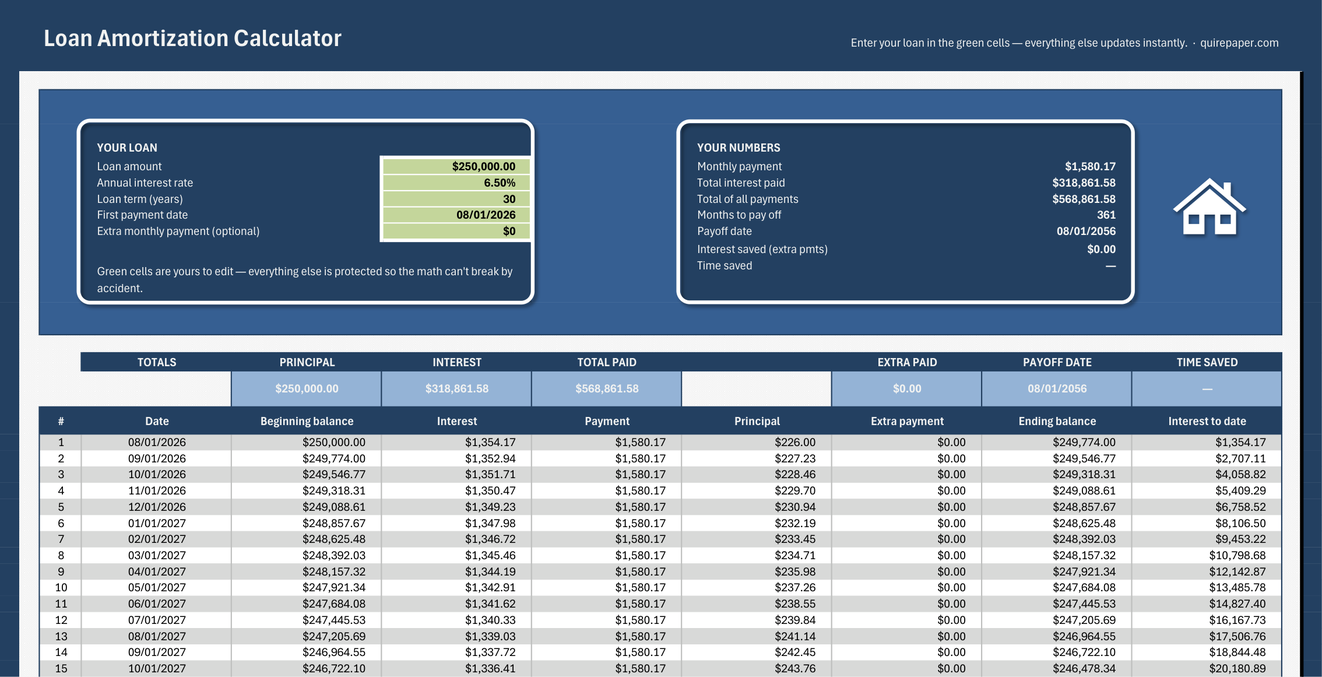
Payment, payoff date, and every month in between — plus what an extra payment really saves you. Works for any fixed-rate loan.

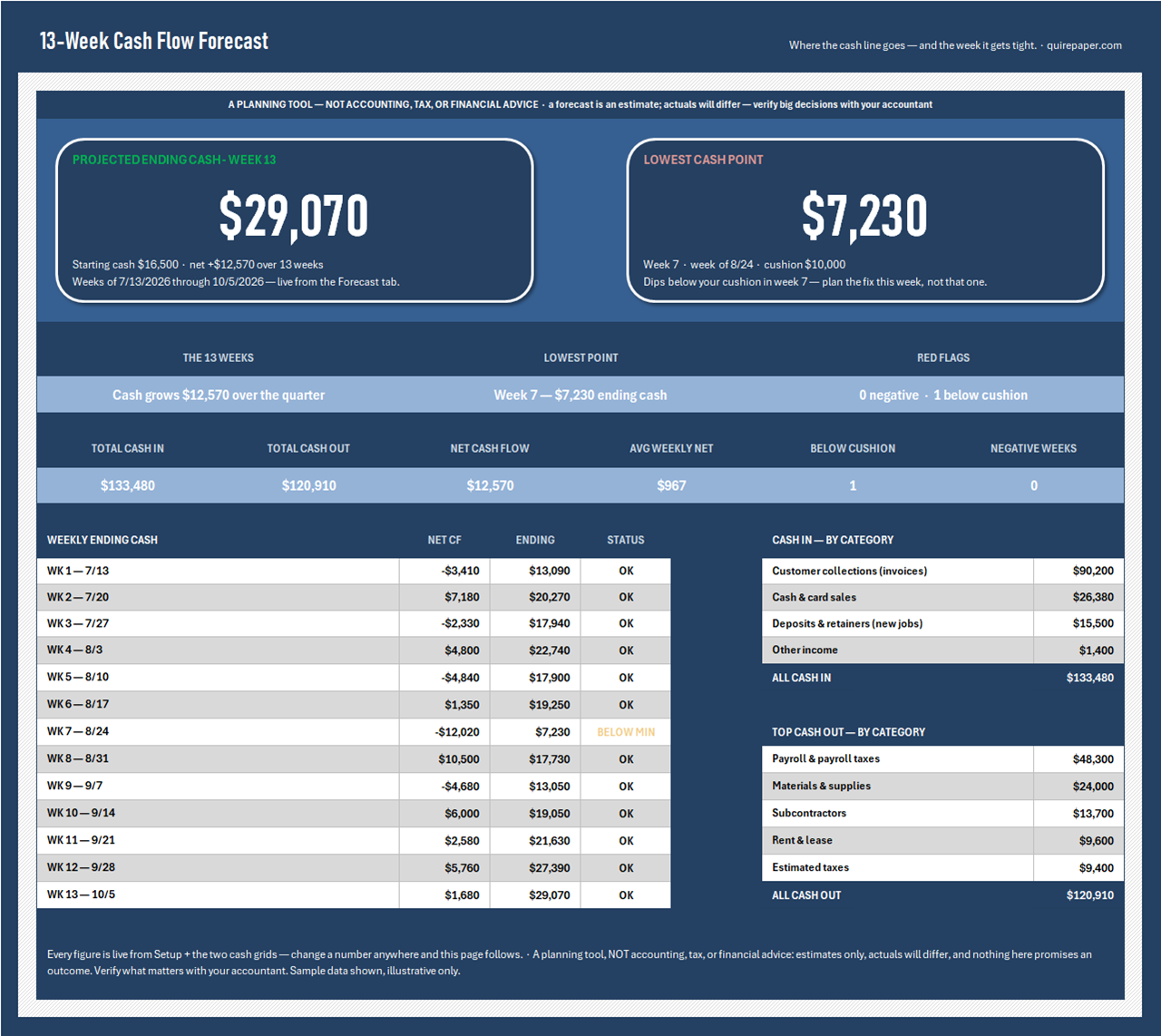
Thirteen weeks of cash in and cash out, rolled into a live ending-cash line — the week it gets tight flags itself. Lowest-point marker, below-cushion ambers, negative reds, and a dashboard that reads the whole quarter. The standard rolling small-business cash tool, built as a formula engine.

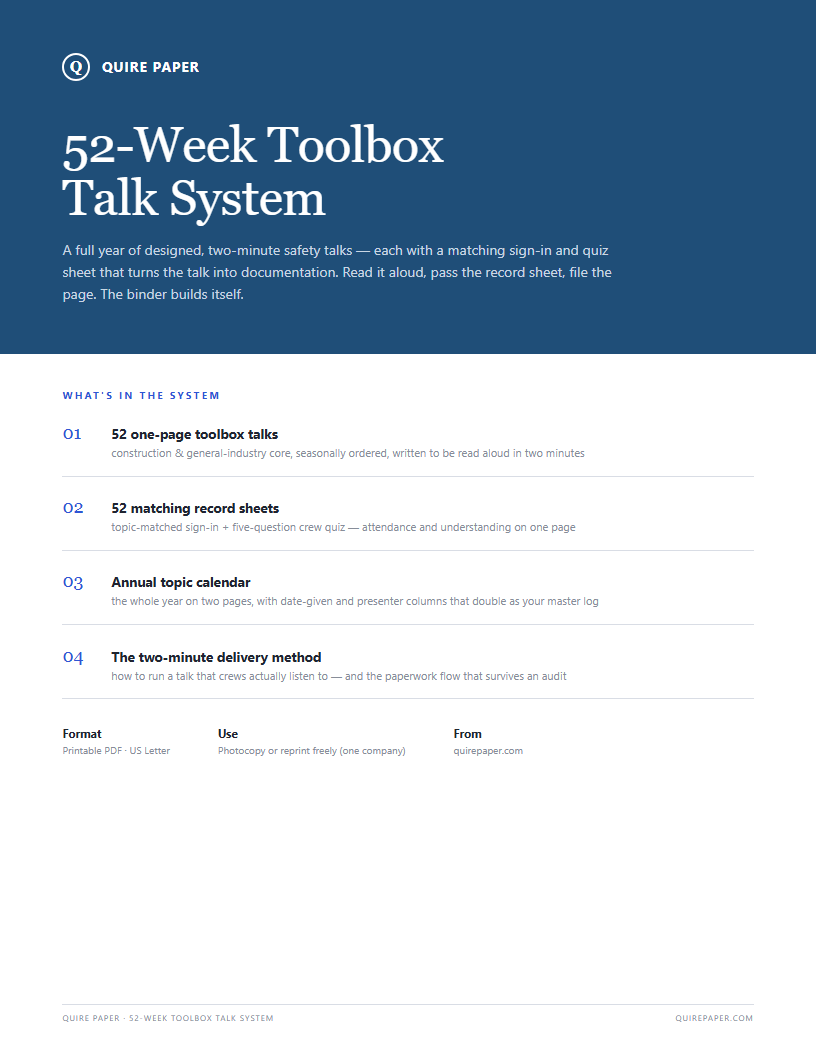
A full year of designed two-minute safety talks — 52 one-page talks, each with a matching sign-in + quiz record sheet, an annual topic calendar, and the delivery method. Now with every talk as an editable PowerPoint deck and Word sheet, so you can put your company on it.

The Spanish edition of our 52-Week Toolbox Talk System: a full year of designed, two-minute jobsite safety talks — in Spanish — each with a matching sign-in + quiz record sheet, an annual topic calendar, and a delivery guide. For crews that run their talks in Spanish. Charlas de seguridad, listas para leer.
Every bid on one dashboard — pipeline value, hit rate, what's due in the next two weeks — plus a line-item estimate worksheet that builds the bid price itself, from divisions to overhead, profit, and contingency.

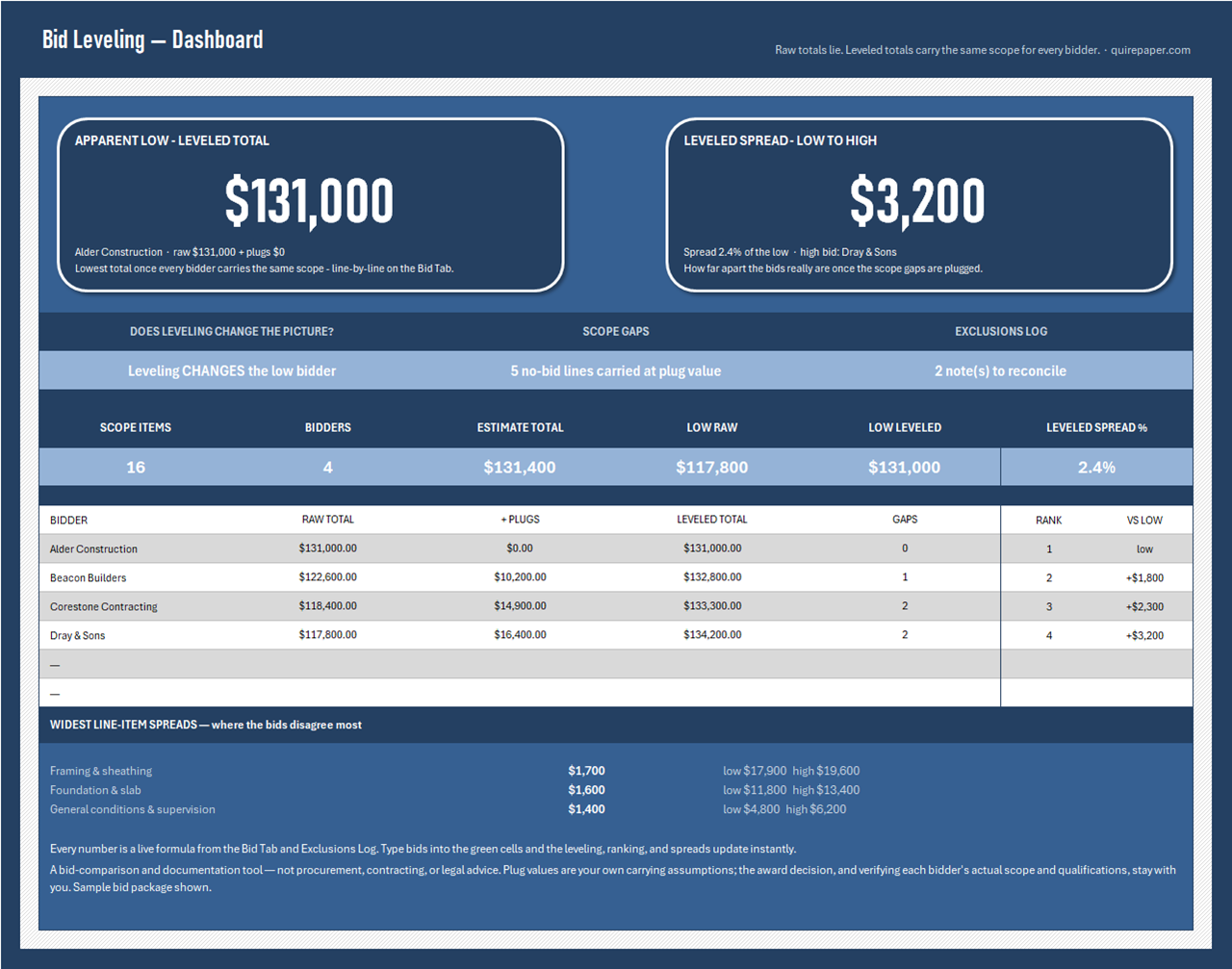
Raw totals lie — the cheapest-looking bid is often just the emptiest one. Compare 4–6 sub or vendor bids line-by-line across your scope items, plug the gaps where a bidder excluded or no-bid a line, and read leveled totals that carry the SAME scope for every bidder — with auto low/high/spread per line, red scope-gap flags, a leveled ranking, and an exclusions log. Four tabs, pure formulas, no macros.

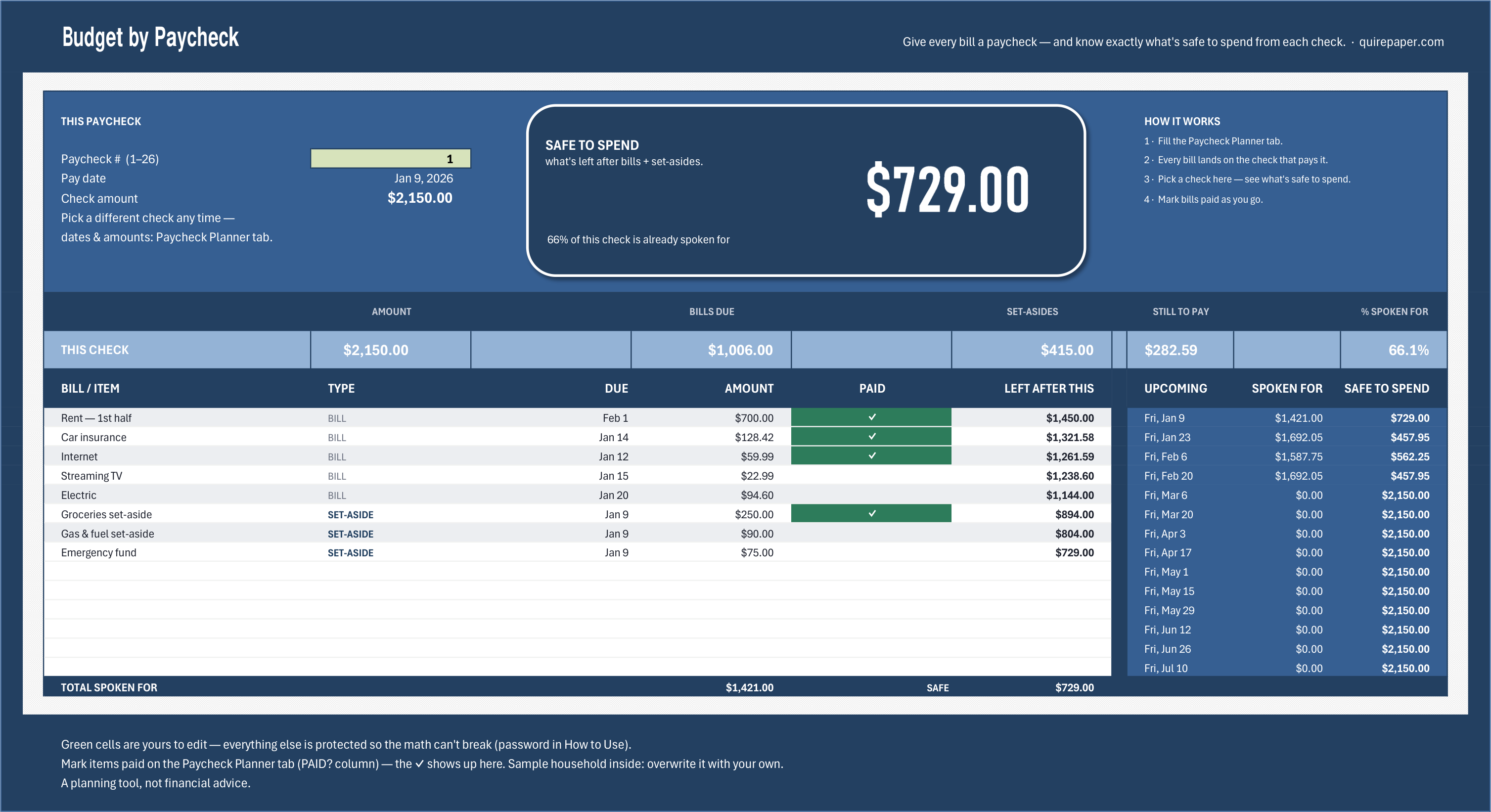
Give every bill a paycheck and see exactly what's safe to spend from each check — 26 paychecks mapped, a 60-bill register, and one dark dashboard that does the math.

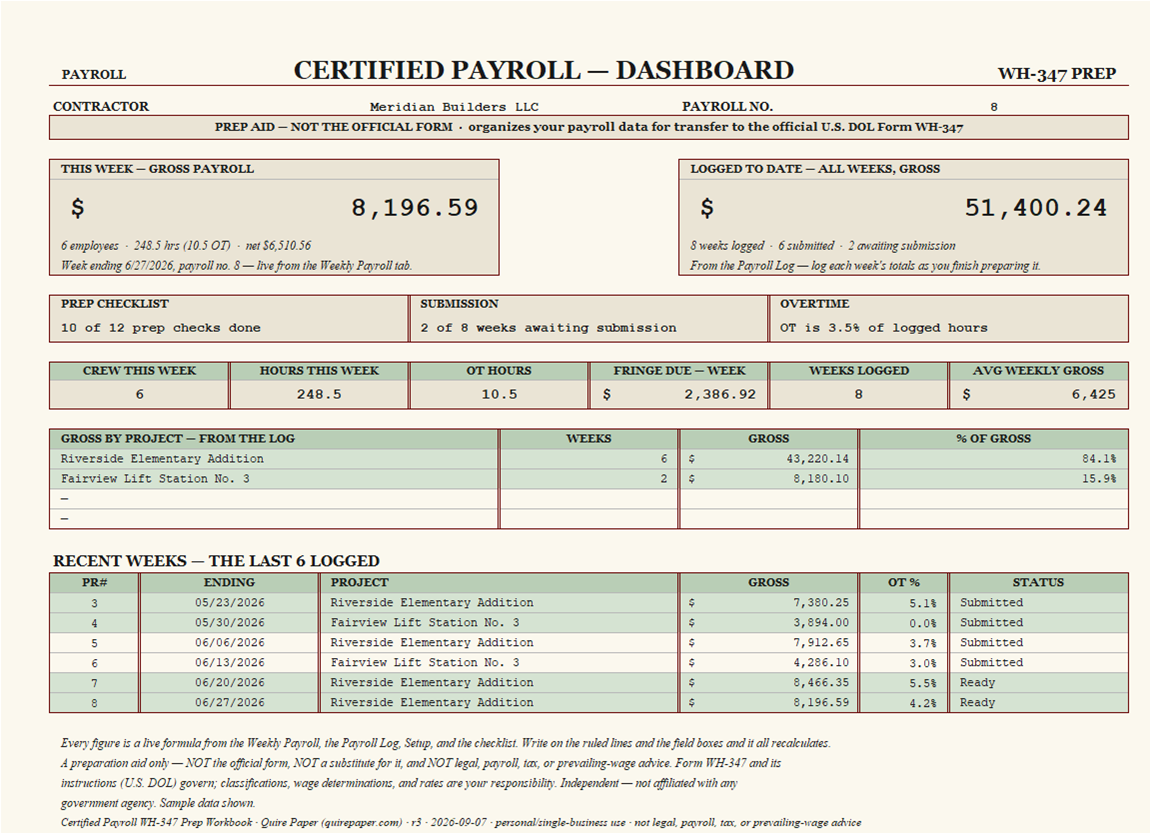
Every Davis-Bacon job means certified payroll every week — and the WH-347 is a slow form to fill from scratch. This workbook organizes the week the way the form reads: classification rates you set once, O/S daily hours per worker, auto gross (ST × base + OT × 1.5 × base), fringe obligation, deductions to net — then a Statement-of-Compliance prep checklist, a multi-week log, and a dashboard. Transfer line by line to the official DOL form. A prep aid — not the form itself.

Bookkeeping built the way construction money actually moves: every transaction carries a JOB code, so the same two ledgers produce a By-Job P&L (billed, direct costs by category, gross profit, margin — per job), a cash-basis Monthly P&L with overhead as its own honest line, and a dashboard that names your best and worst jobs. One sample job loses money on purpose — that red row is the point. A record-keeping tool, not accounting advice.
A construction loan doesn't fund all at once — it funds draw by draw, and it charges interest on every dollar the day it lands. This workbook runs the whole loan: an earned-value draw schedule by construction phase (budget × % complete − previously drawn = this draw request), a draw log with a live actual/365 interest-carry chain, and a dashboard reading utilization, remaining availability, interest vs reserve, and pending draws. Five tabs, pure formulas, no macros.

Bill a progress payment in minutes — an original AIA-style application for payment with a schedule of values, retainage on work and stored materials, and change-order math that ties out to the cent. The application foots every time.

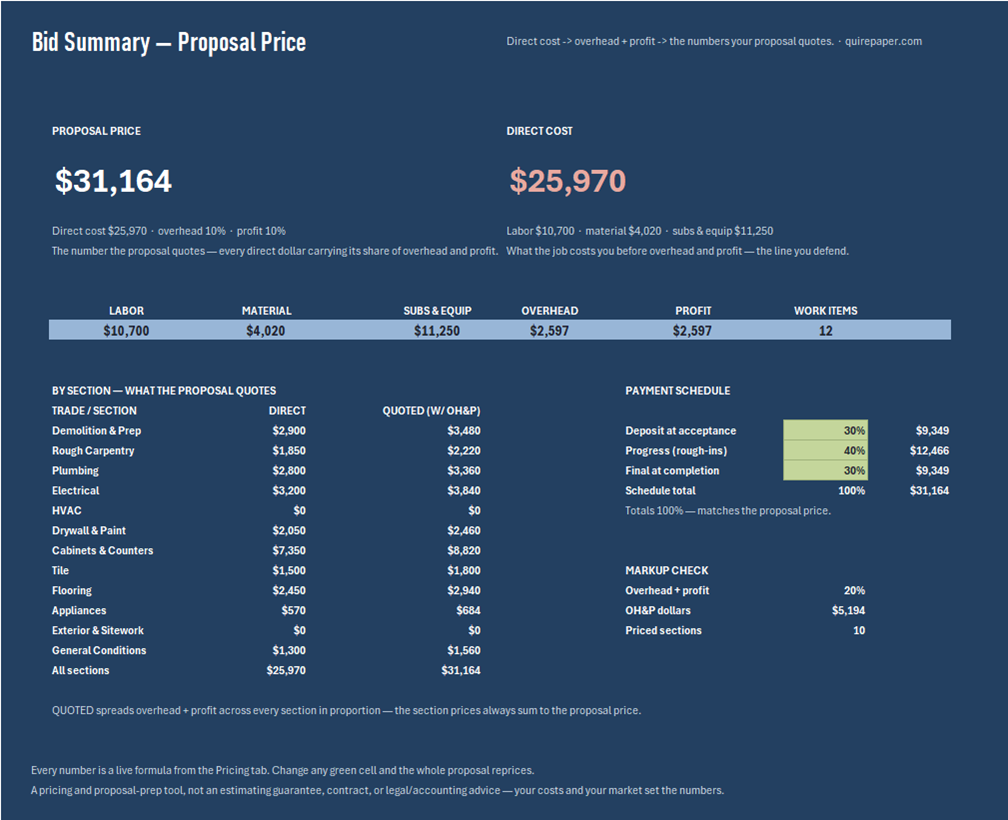
The proposal that wins the job and prevents the fight: real scope-of-work language written trade by trade by a licensed architect, an exclusions page that stops the "I assumed that was included" conversation, and an Excel pricing worksheet that generates every number the proposal quotes.

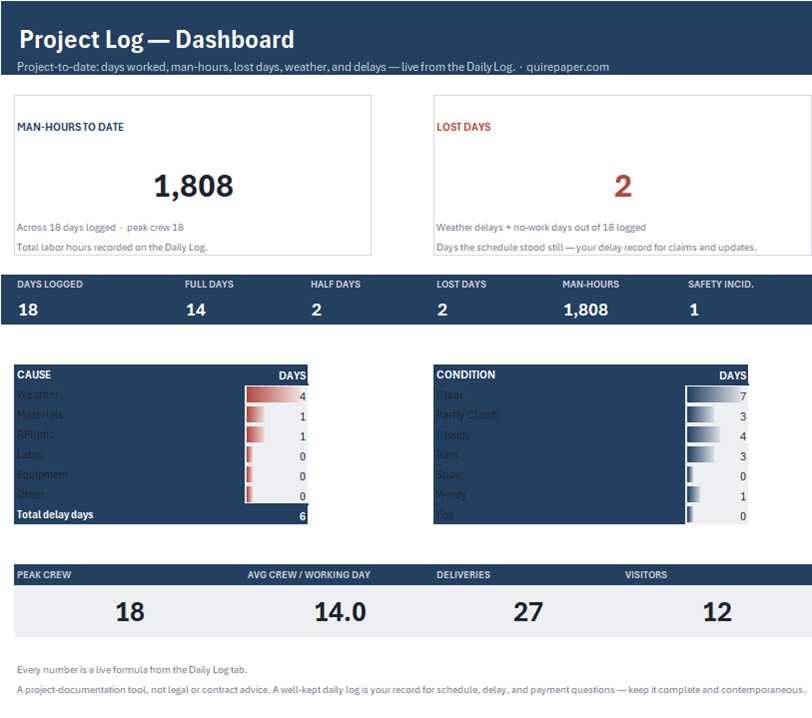
A superintendent's daily field log: one row per day — weather, crew, man-hours, deliveries, delays, safety — that rolls up to man-hours, lost days, and delay causes on a live dashboard, plus a print-ready daily report form for the trailer.

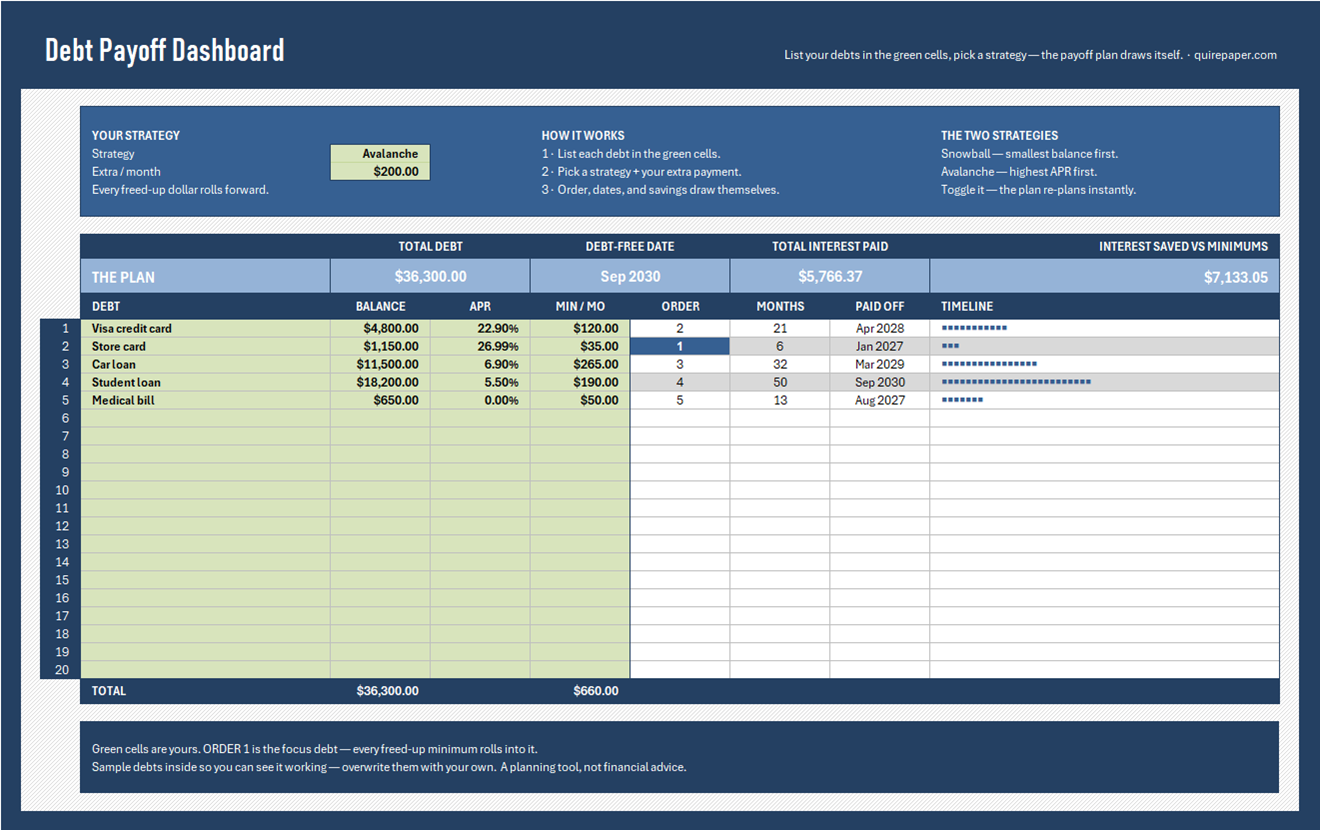
List up to 20 debts, pick snowball or avalanche — see your debt-free date and the interest you'll never pay.

Take bookings on your own site and keep the fees: a complete direct-booking website for short-term rentals — live calendar, card payments, Airbnb & VRBO sync, demand pricing, and a real automation API. You own the code; no monthly SaaS. One repeat guest a year pays for it.

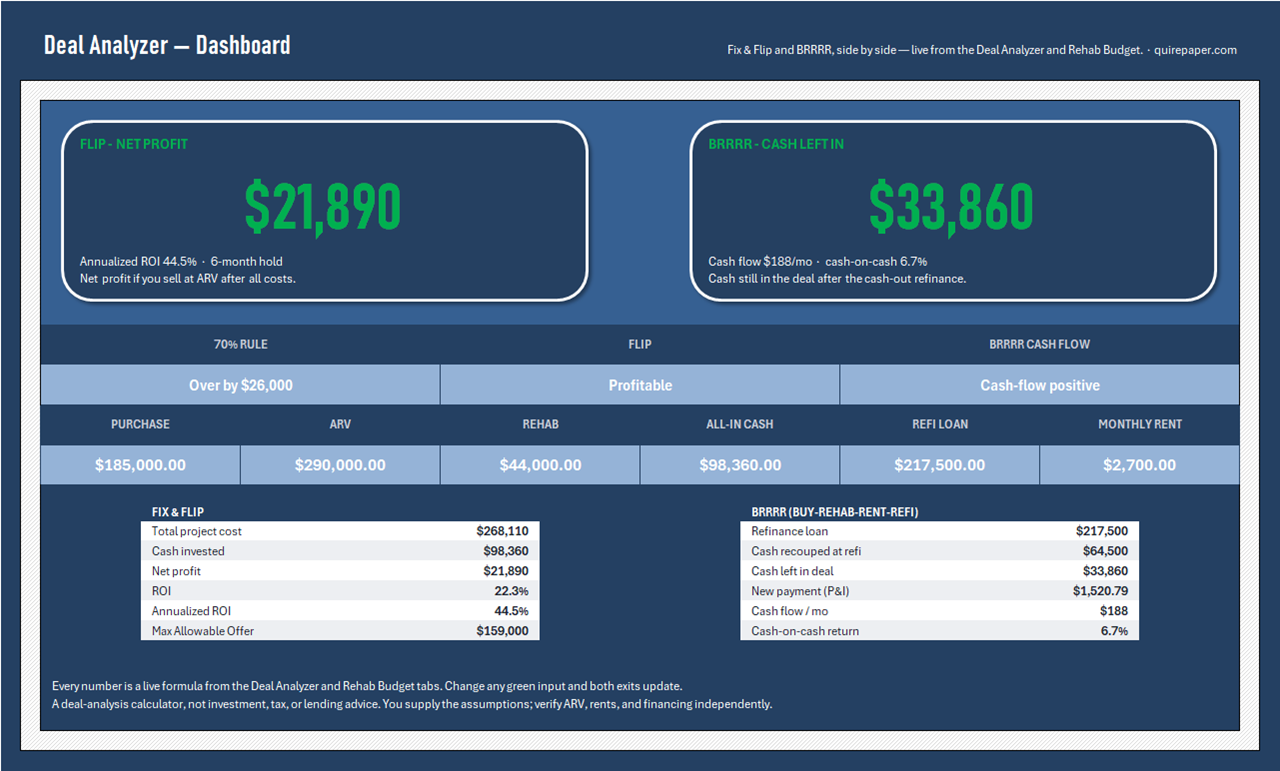
One model, two exits: run a Fix & Flip and a BRRRR off the same numbers — net profit, ROI, the 70% rule, cash-out refinance, cash flow, and cash-on-cash — fed by a rehab budget you estimate the way a contractor does, by construction division. Four tabs, pure formulas, no macros.

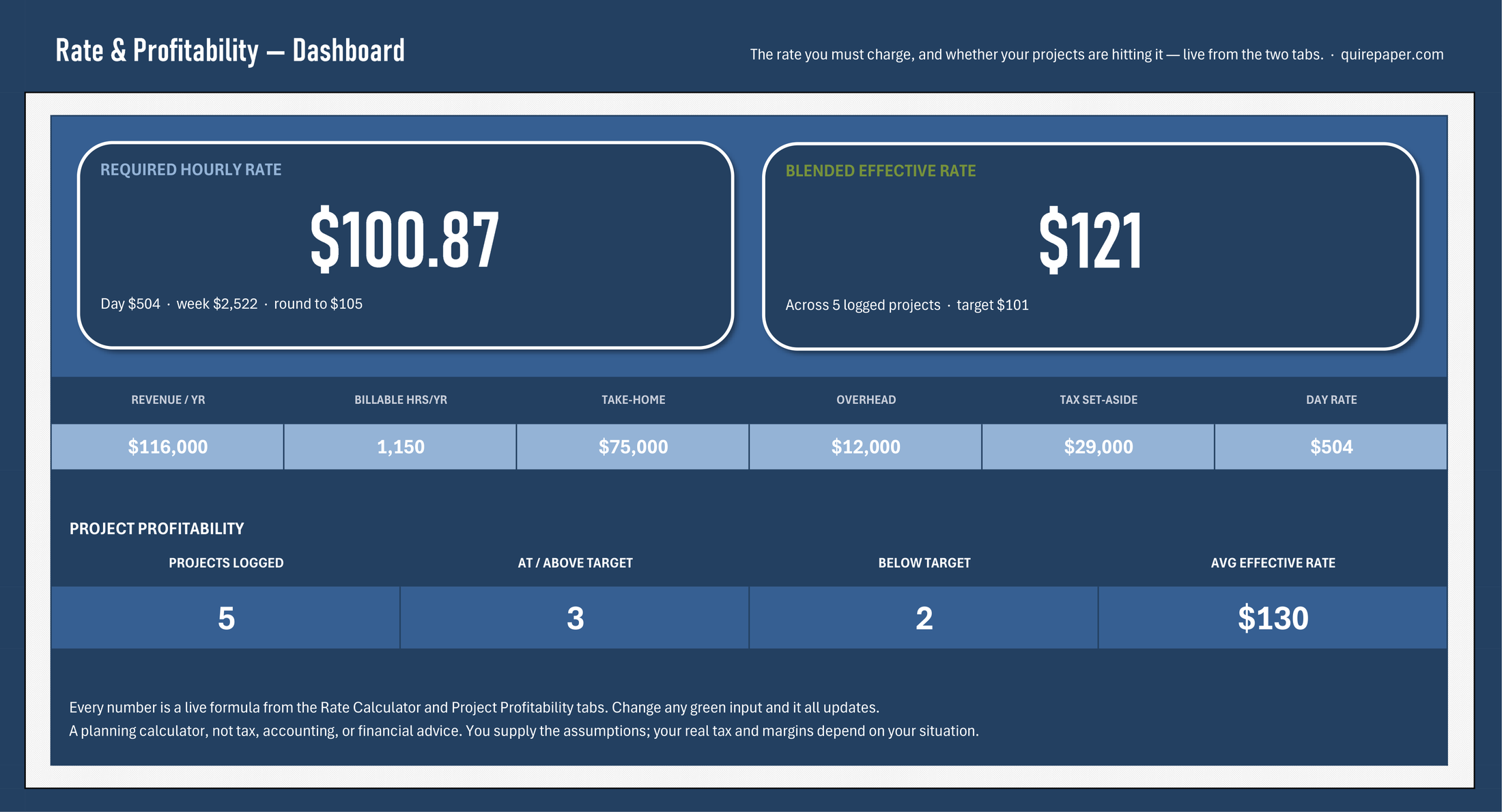
Stop guessing your rate. Back into the hourly, day, and week rate you must charge — from what you want to take home, your overhead, your tax set-aside, and your REAL billable hours — then log each project to see whether it actually hit that rate. Three tabs, pure formulas, no macros.

A 12-week goal workbook held lightly: tiny-rung ladders, light weekly check-ins, and a mid-season permission slip. From our Daily Reset line.

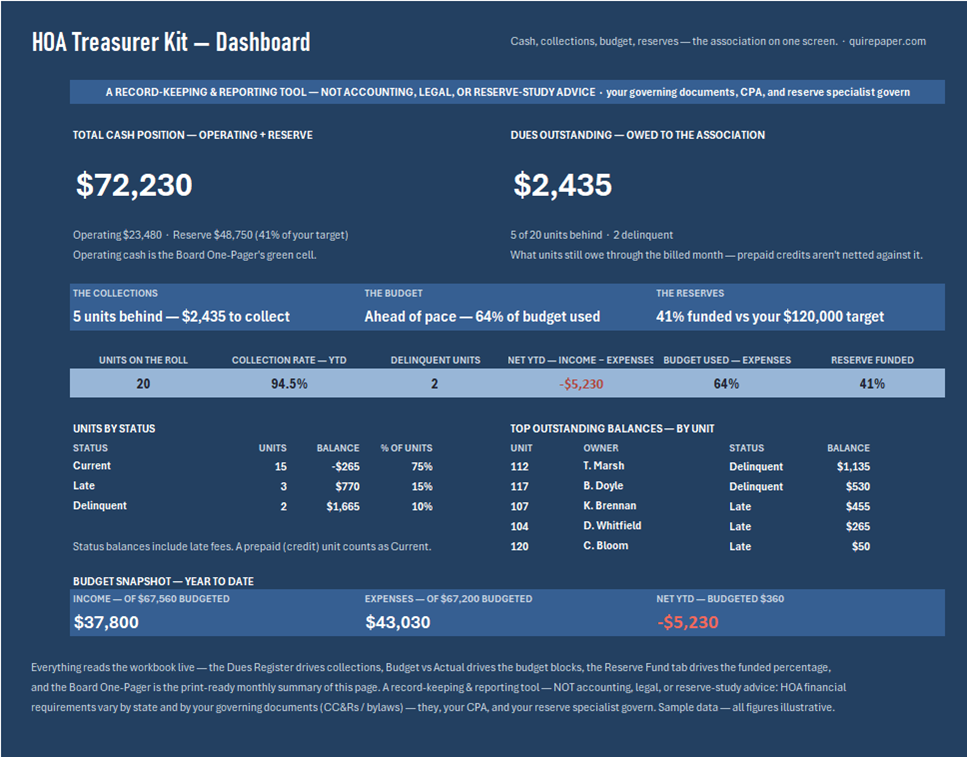
The volunteer treasurer's workbook for a small self-managed HOA or condo association. A per-unit dues register (monthly or quarterly assessments, a Jan–Dec payment grid, auto billed/paid/balance and Current/Late/Delinquent status at YOUR threshold), budget vs actual with over-pace flags, a reserve-fund tracker measured against your own reserve-study target, and a print-ready Board One-Pager — the sheet you hand the board every month. A record-keeping tool, not accounting or legal advice.

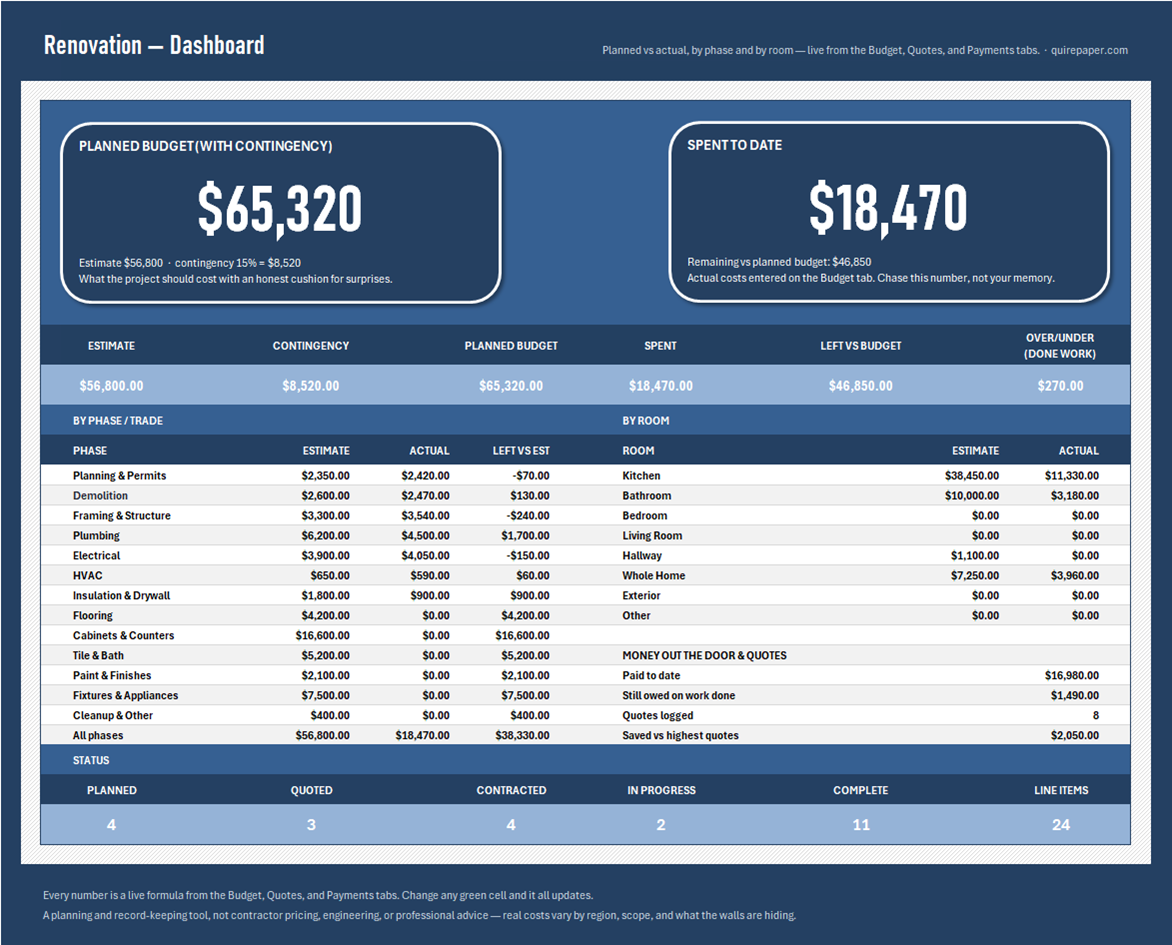
A renovation budget built the way an architect phases a project — by trade, in build order, with room tags. Contingency held on top, planned-vs-actual variance, contractor-quote comparison, and a payments log that knows what you still owe. Five tabs, pure formulas, no macros.

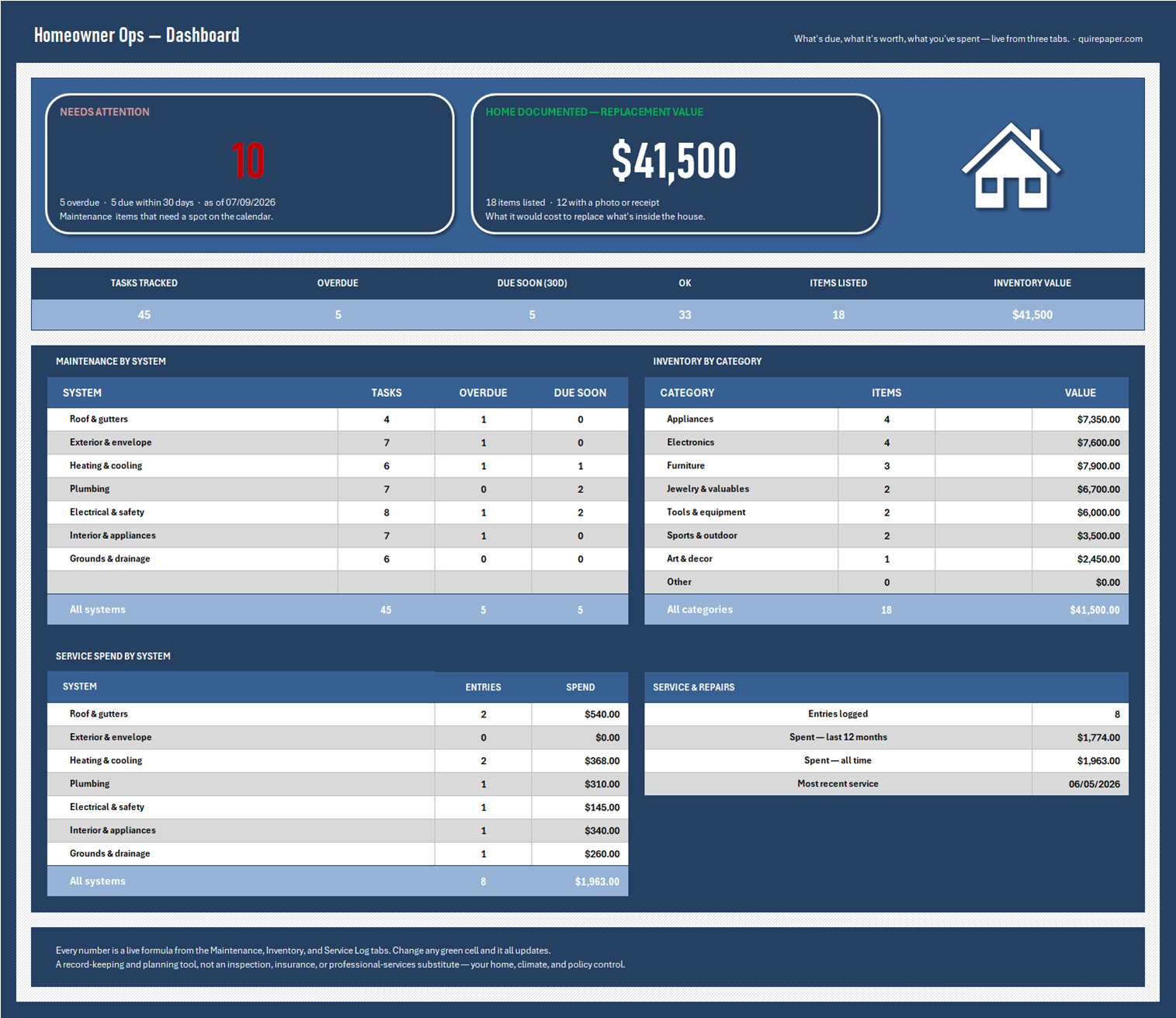
The three records every house should have, from a licensed architect: a maintenance schedule with a live due engine (45 curated tasks — roof, envelope, mechanicals), an insurance-ready home inventory with replacement value by category, and a service log that proves the house has been cared for. Four working tabs, pure formulas, no macros.

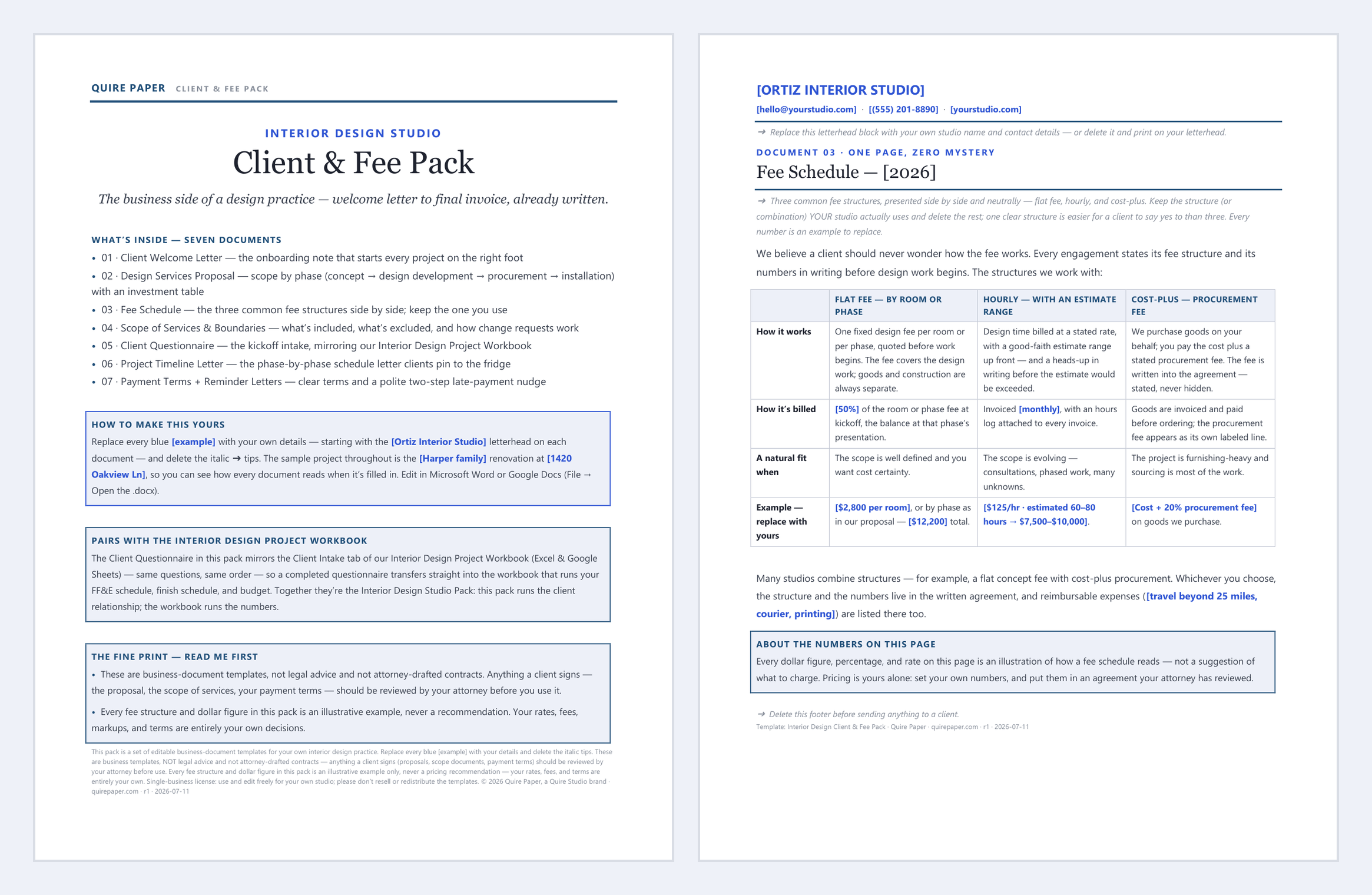
The business side of a design practice, already written: client welcome letter, design services proposal with a phase-by-phase scope and investment table, a fee-schedule one-pager (flat, hourly, and cost-plus side by side), scope of services & boundaries, a client questionnaire that mirrors our Interior Design Project Workbook, a project timeline letter, and payment terms with a two-step late-payment reminder pair. Replace the blue example text with your studio's details.

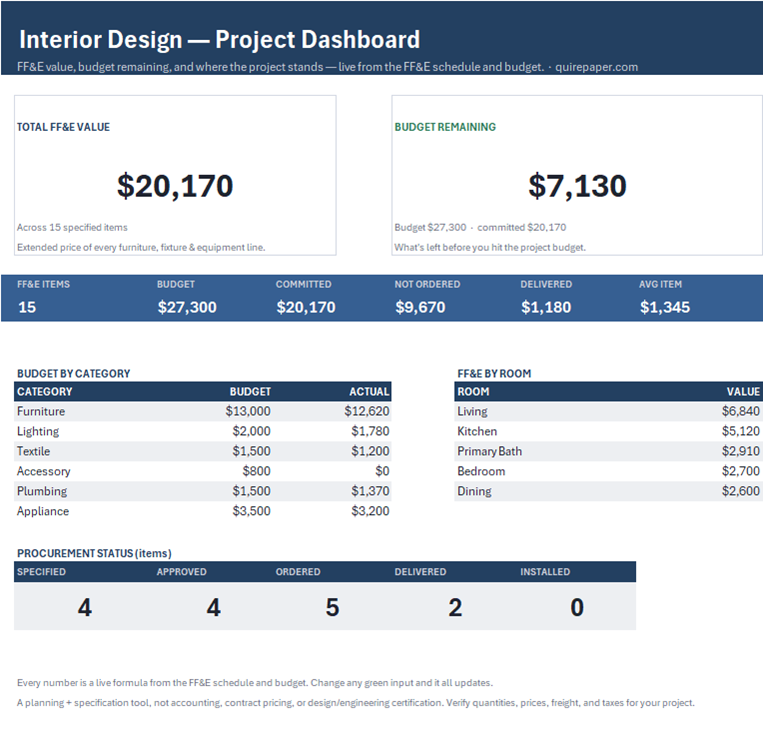
The design file with real numbers: an FF&E schedule that costs itself (qty × unit → extended price, procurement status), a room-by-surface finish schedule, a budget that pulls its actuals straight from your FF&E selections, a client intake questionnaire, and a live rollup dashboard. Six tabs, pure formulas, no macros.
Send a clean invoice — and always know who still owes you. A fillable, printable invoice plus a tracker that shows what's outstanding, what's overdue, and what got paid this month, with an aging breakdown. No subscription, no per-invoice fee.
Every project's budget, committed costs, and actuals on one dark dashboard — cost to complete, projected at completion, and the margin you're actually going to make, by cost division, with OK / WATCH / OVER status on every line.

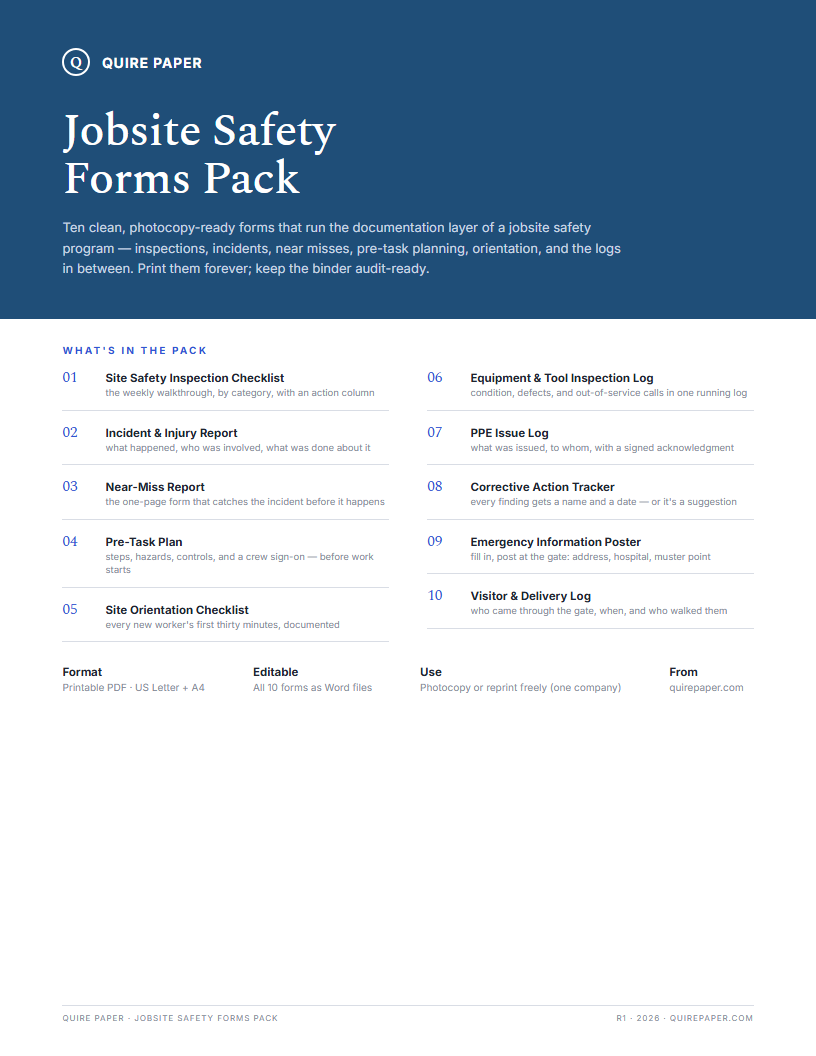
Ten photocopy-ready forms that run the documentation layer of a jobsite safety program — inspections, incidents, near misses, pre-task plans, orientation, and the logs in between. PDF plus editable Word versions of every form.
Your whole rental portfolio in one workbook: a rent roll (with a live lease-expiration engine), a rent ledger, and a maintenance log that roll up to occupancy, collections, expiring leases, and open repairs on one dashboard. For small-portfolio, long-term-rental landlords.
Every lease's days-to-end and status — Active, Renewal window, Expiring soon, Expired, Month-to-month — plus your renewal offers, the tenants' responses, the auto % increase, and a notice-deadline timeline for every unit. The renewal season, run from one workbook.

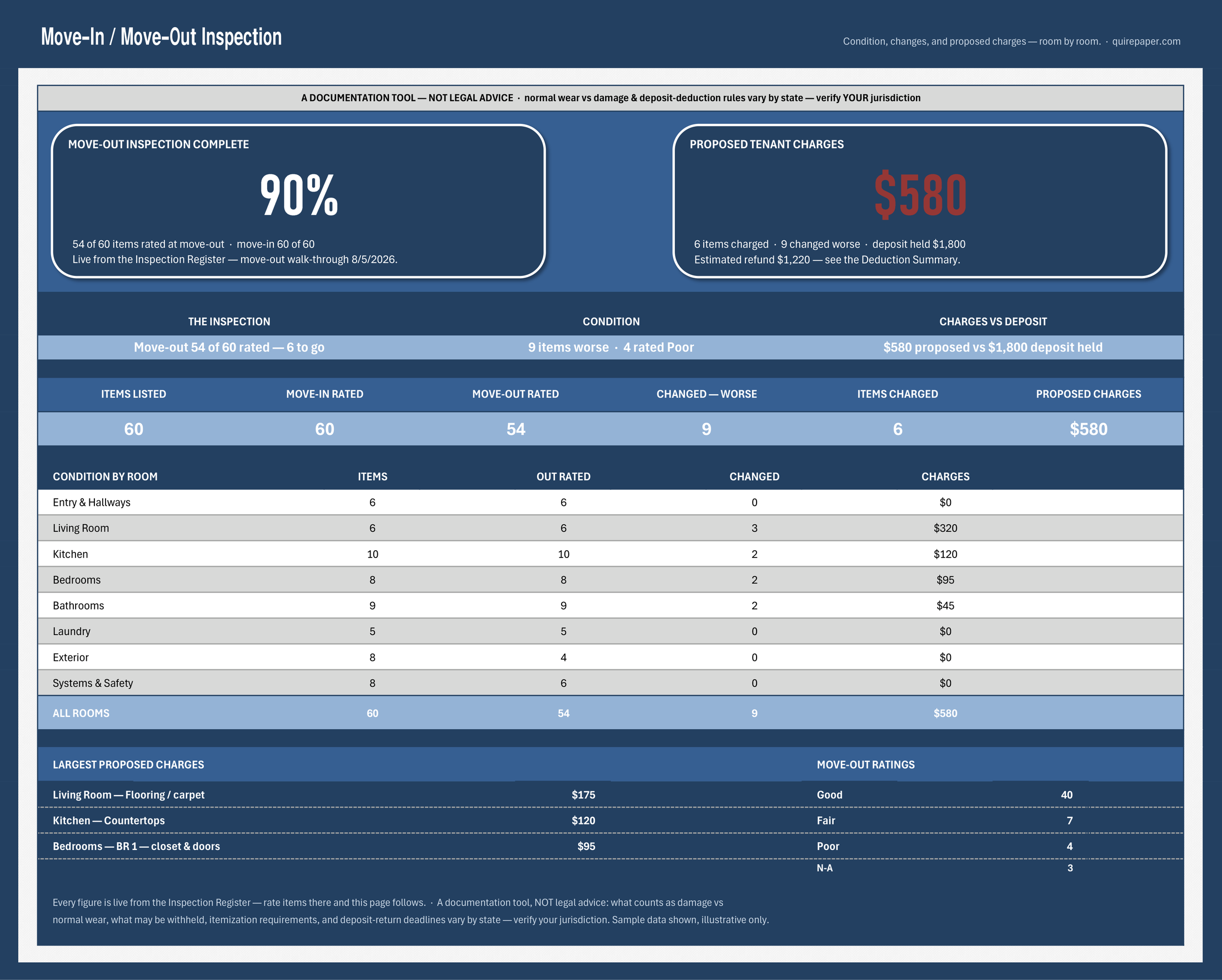
60 items, room by room — rated Good / Fair / Poor at move-in and again at move-out, with automatic CHANGED flags when condition comes back worse, your proposed tenant charges, and a deduction summary against the deposit. The walk-through, documented properly.

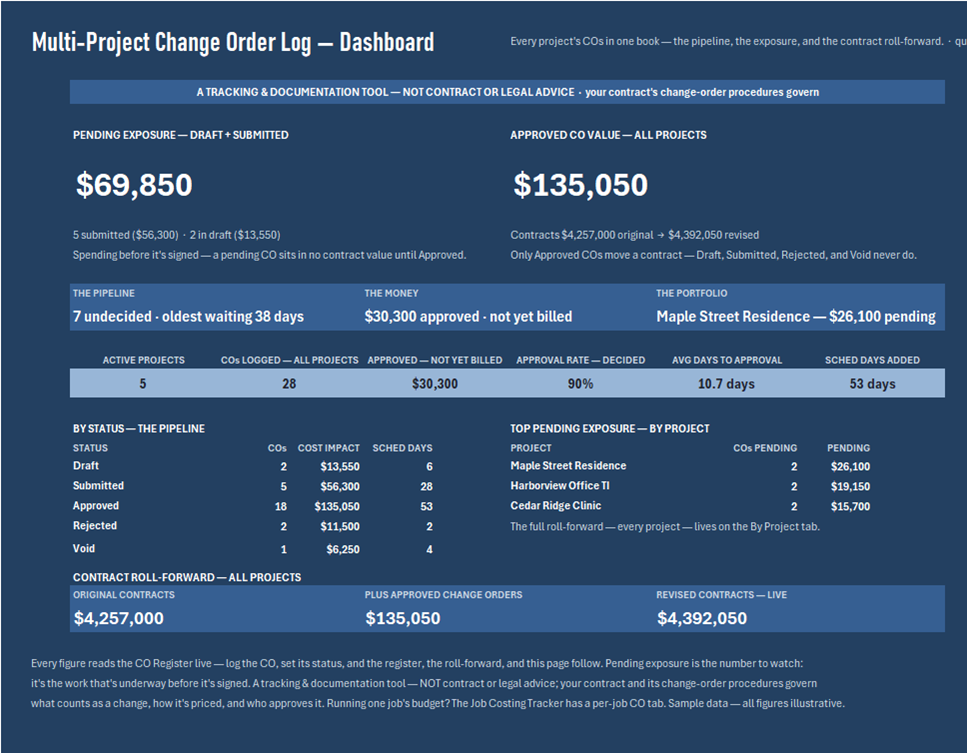
Every project's change orders in one book — not another single-job form. A 70-row register (project, CO #, cost and schedule impact, Draft/Submitted/Approved/Rejected/Void) feeds a per-project contract roll-forward (original + approved = revised), a PENDING EXPOSURE hero — the work you may be doing before it's signed — approved-but-unbilled flags, approval rate, and average days to approval. A tracking tool, not contract advice.

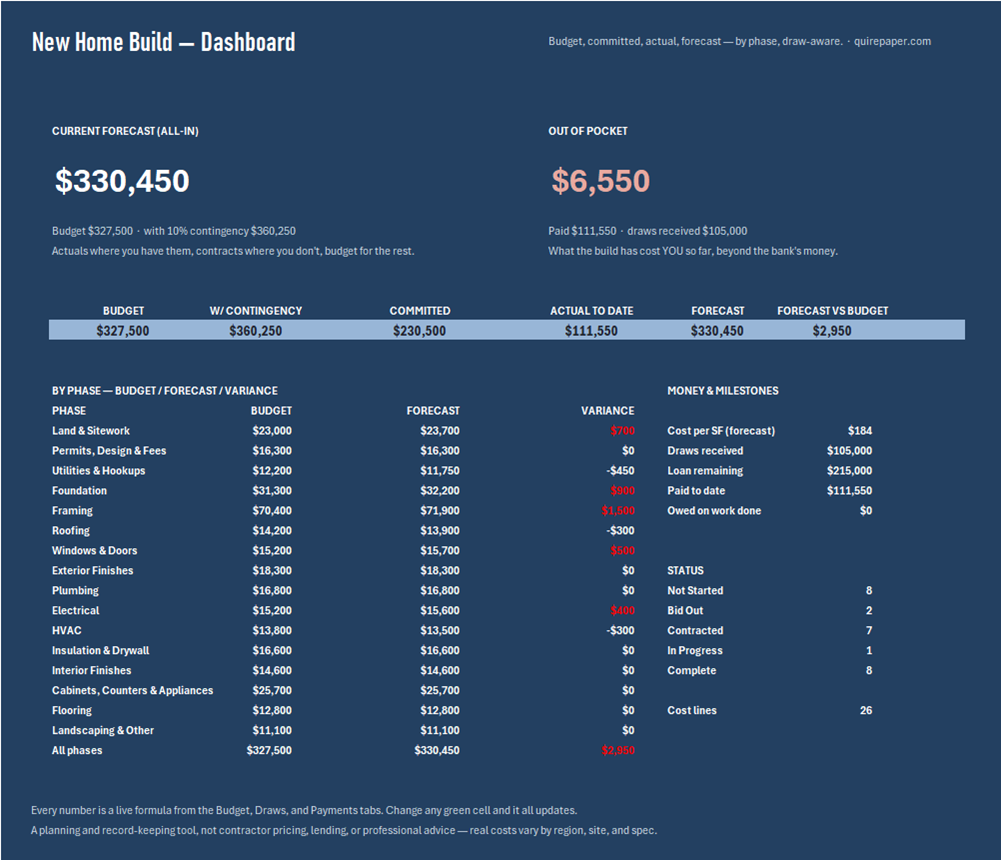
Cost control for building a house, from a licensed architect: sixteen phases from sitework to landscaping, budget → committed → actual → forecast on every line, a construction-loan draw log, and the out-of-pocket number owner-builders feel but rarely see. Five tabs, pure formulas, no macros.

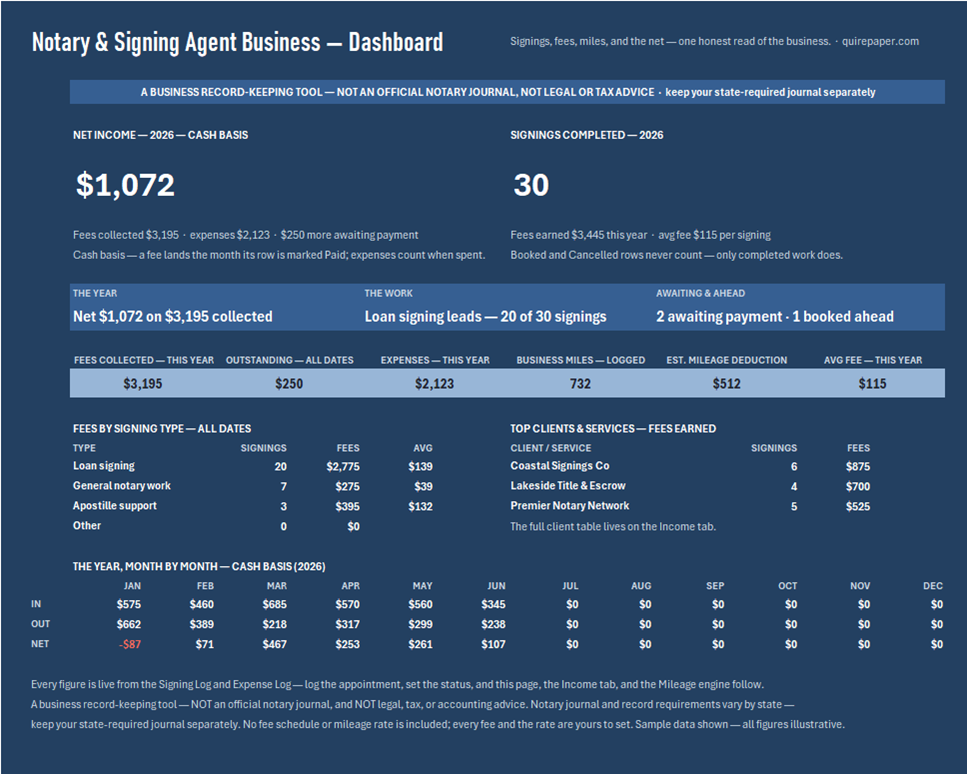
The business side of a mobile notary / signing agent practice, in one workbook: a Signing Log (fee, miles, travel time, payment status) that feeds income by month, by signing type, and by client; an Expense Log with a live category rollup; and a mileage engine that turns your driving into an estimated deduction at a rate YOU set. Not an official notary journal — keep your state-required journal separately.

A repeatable method for capturing a person's memories, voice, and wisdom before the window closes — interview frameworks, a question bank for a year of Sundays, the archive system, and an honest guide to the AI layer on top.

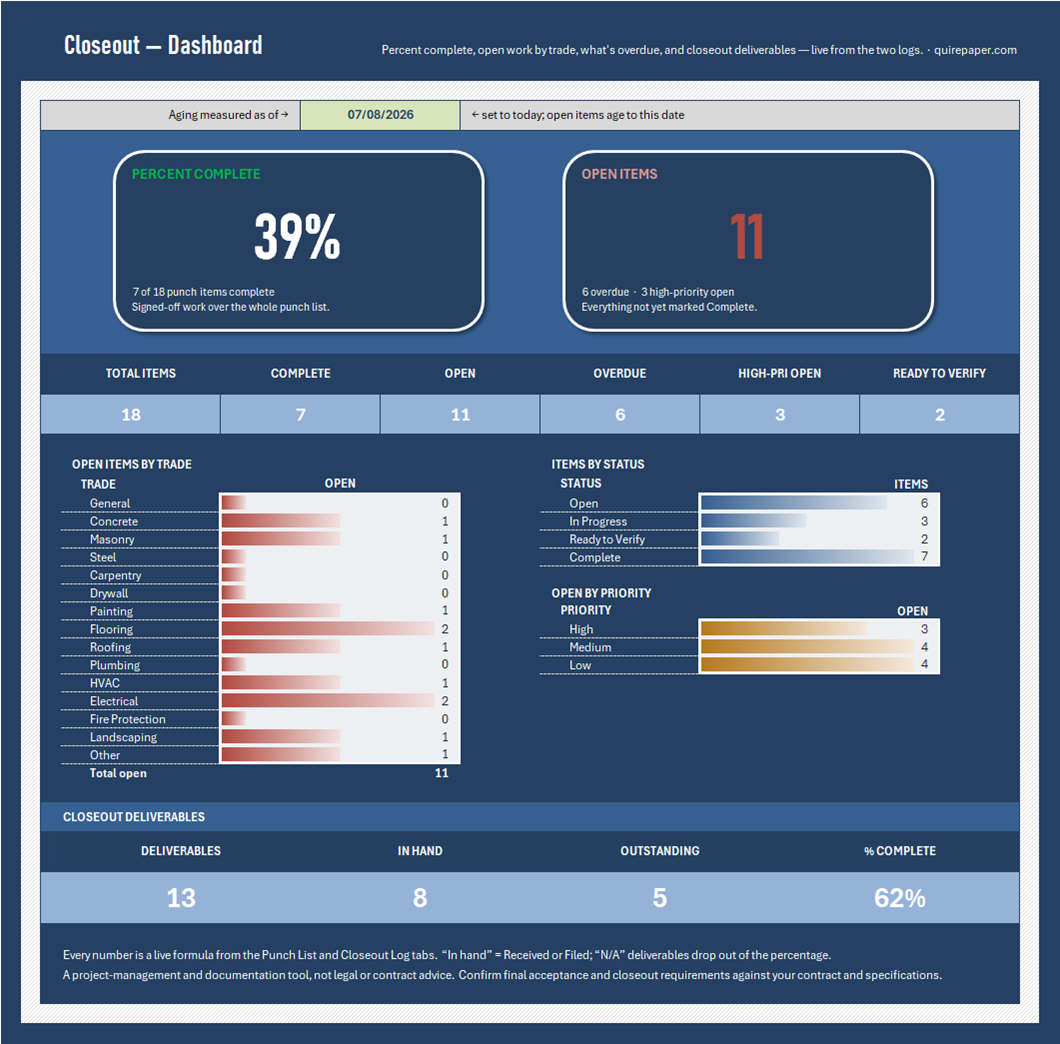
A construction punch list that rolls itself up: log each item once and the dashboard shows percent complete, open work by trade, what's overdue, and where your closeout deliverables stand — warranties, O&M, as-builts, permits. Four tabs, pure formulas, no macros.

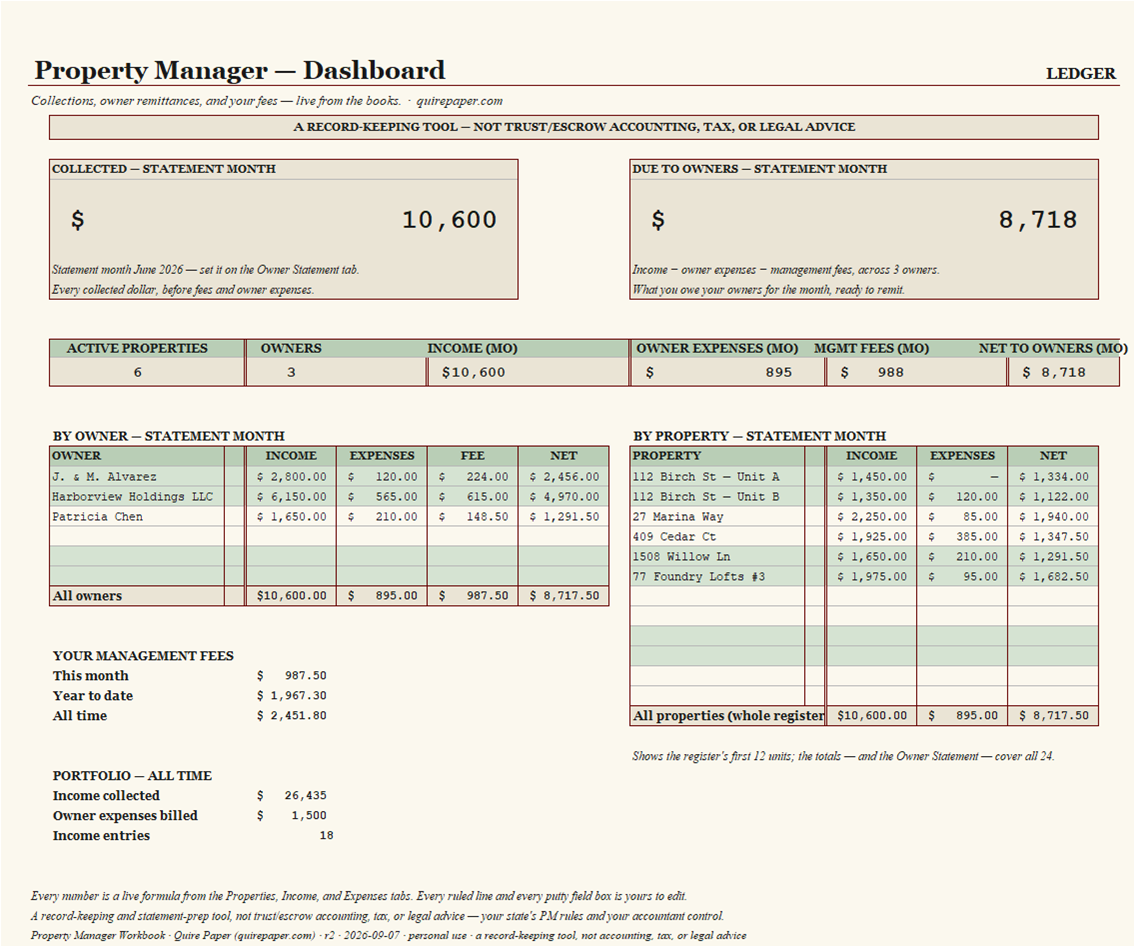
Books for managing other people's rentals: a property + owner register, income and expense logs with auto owner and fee lookups, and the engine generic spreadsheets don't have — pick an owner and a month and the owner statement generates itself, down to NET DUE TO OWNER. Six tabs, pure formulas, no macros.

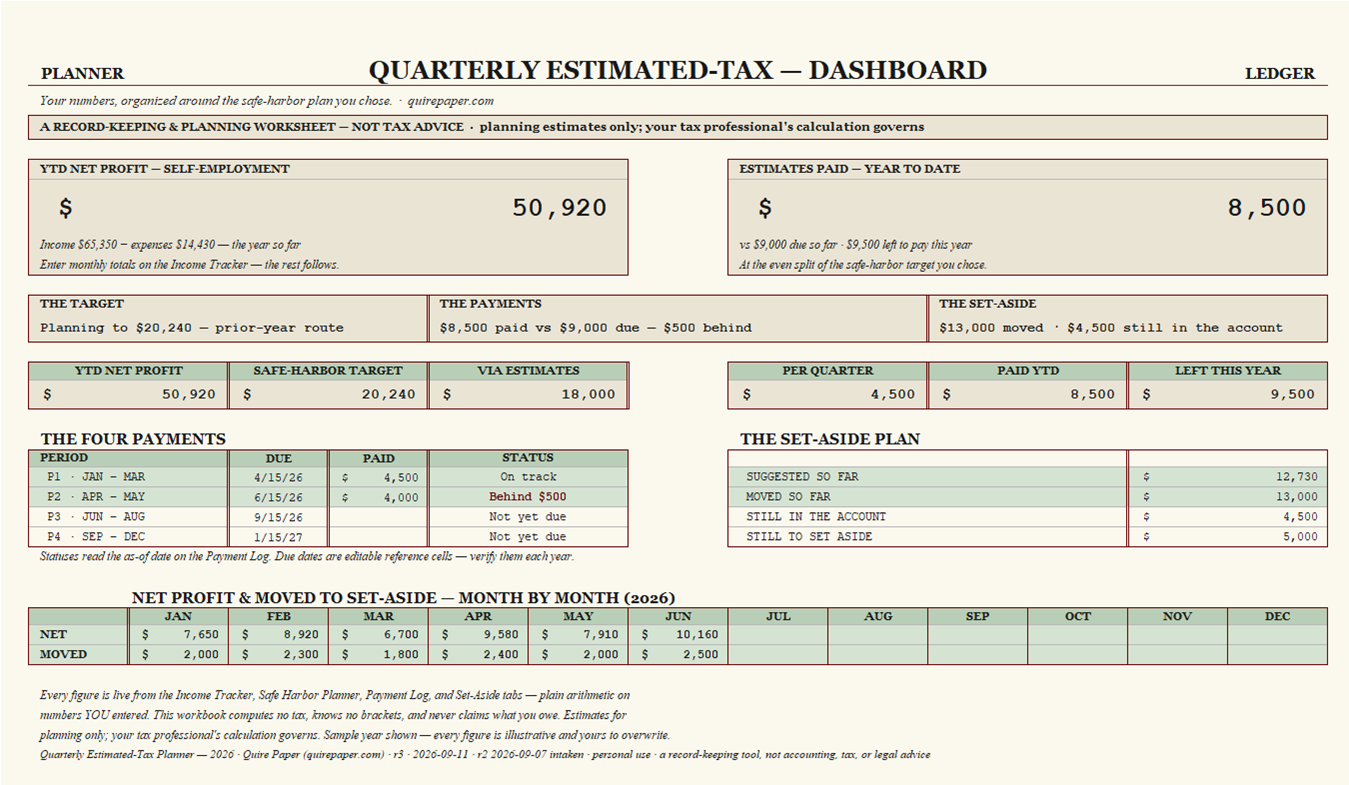
Quarterly estimated taxes, organized instead of dreaded: an Income Tracker for your self-employment year, a Safe Harbor Planner that runs the two standard pay-in routes as plain arithmetic on numbers YOU enter (no brackets, no rates hardcoded — every percentage is an editable reference cell), a Payment Log with the four 2026 due dates and an on-track flag, and a set-aside calculator at a rate you choose. A record-keeping and planning worksheet — not tax advice; your tax professional's calculation governs.
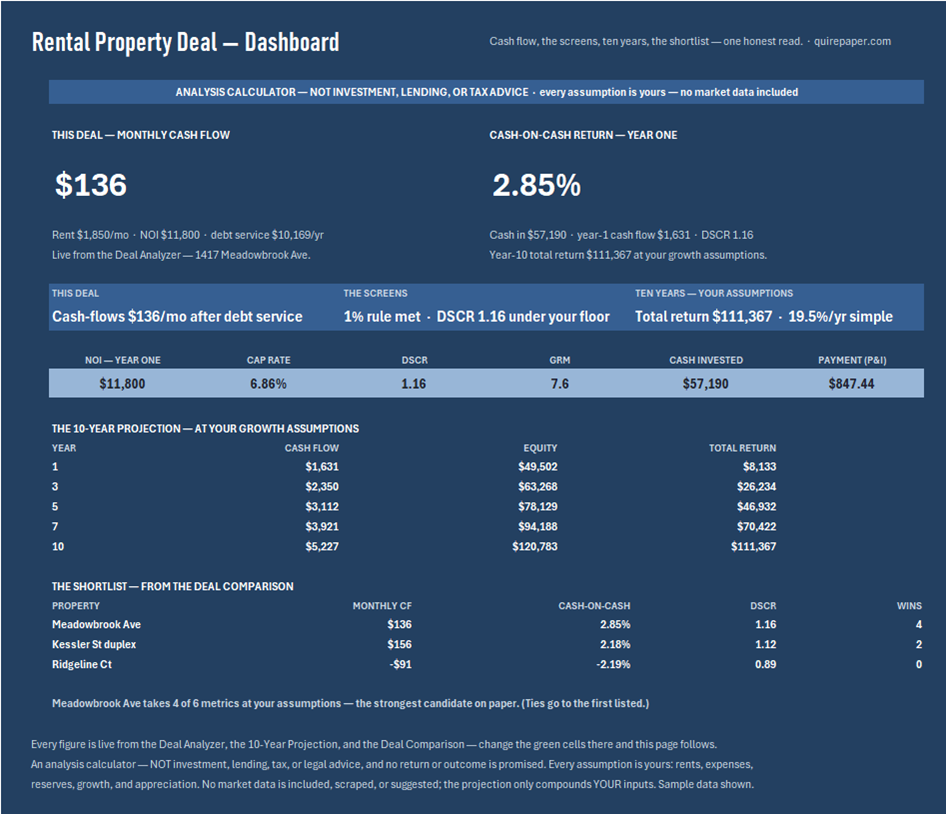
The buy-and-hold analyzer with honest inputs: a contractor-grade make-ready estimate feeding your cash invested, operating expenses BOTH ways (fixed line items plus %-rule reserves for vacancy, maintenance, capex, management), then NOI, cap rate, cash flow, cash-on-cash, DSCR, GRM, and the 1% rule — each with a plain verdict. A 10-year projection compounds YOUR growth assumptions into cash flow, equity, and total return, and a 3-property comparison names the strongest candidate. A calculator — not investment advice; every number is yours.
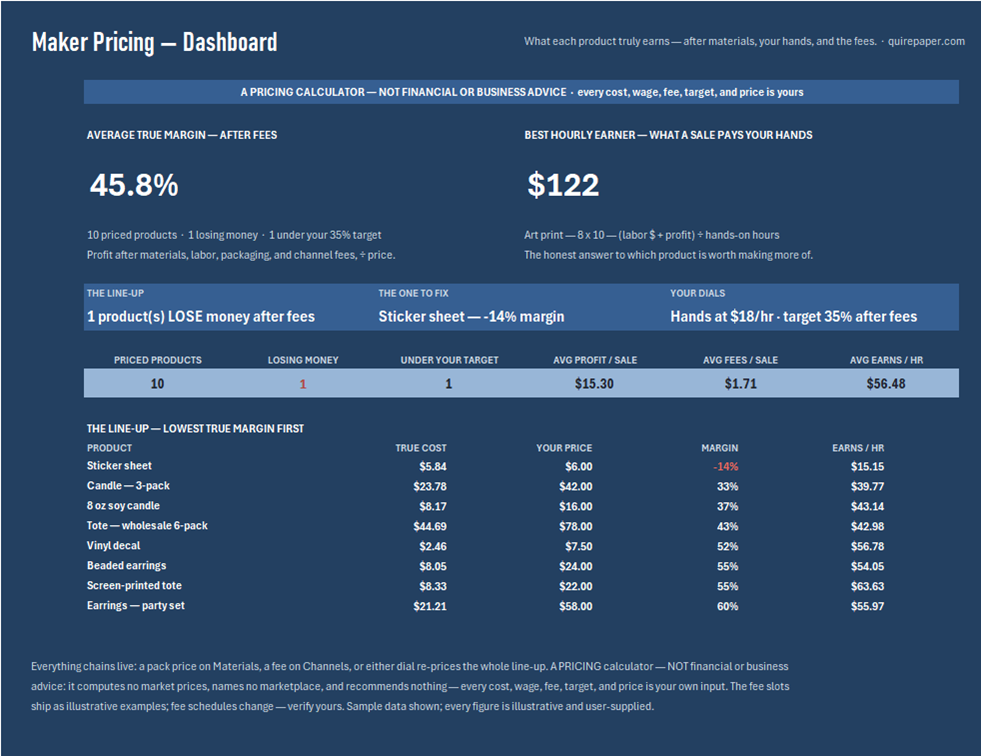
Your whole reselling year on one dashboard — true net profit after fees and shipping, inventory on the shelf, sell-through, days to sell, and which platform is quietly earning the most. eBay, Poshmark, Mercari, Depop, Etsy.
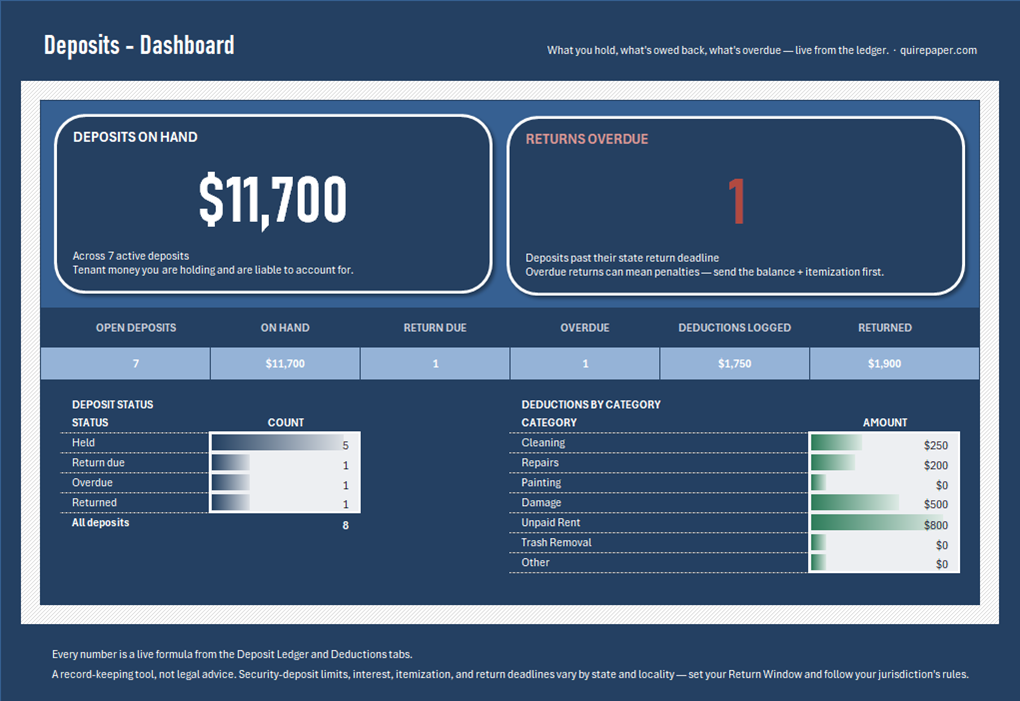
Track every tenant security deposit through its whole life — held, where it's held, itemized move-out deductions, and the state return deadline — so a missed return window never becomes a penalty. Pairs with the Landlord / Rental Property Tracker.
For 1099 contractors, freelancers, and gig workers: log expenses by IRS Schedule C category and business miles by trip, and the workbook totals your deductions, maps them to Schedule C, and estimates the tax they save. A record-keeping tool — not tax advice.

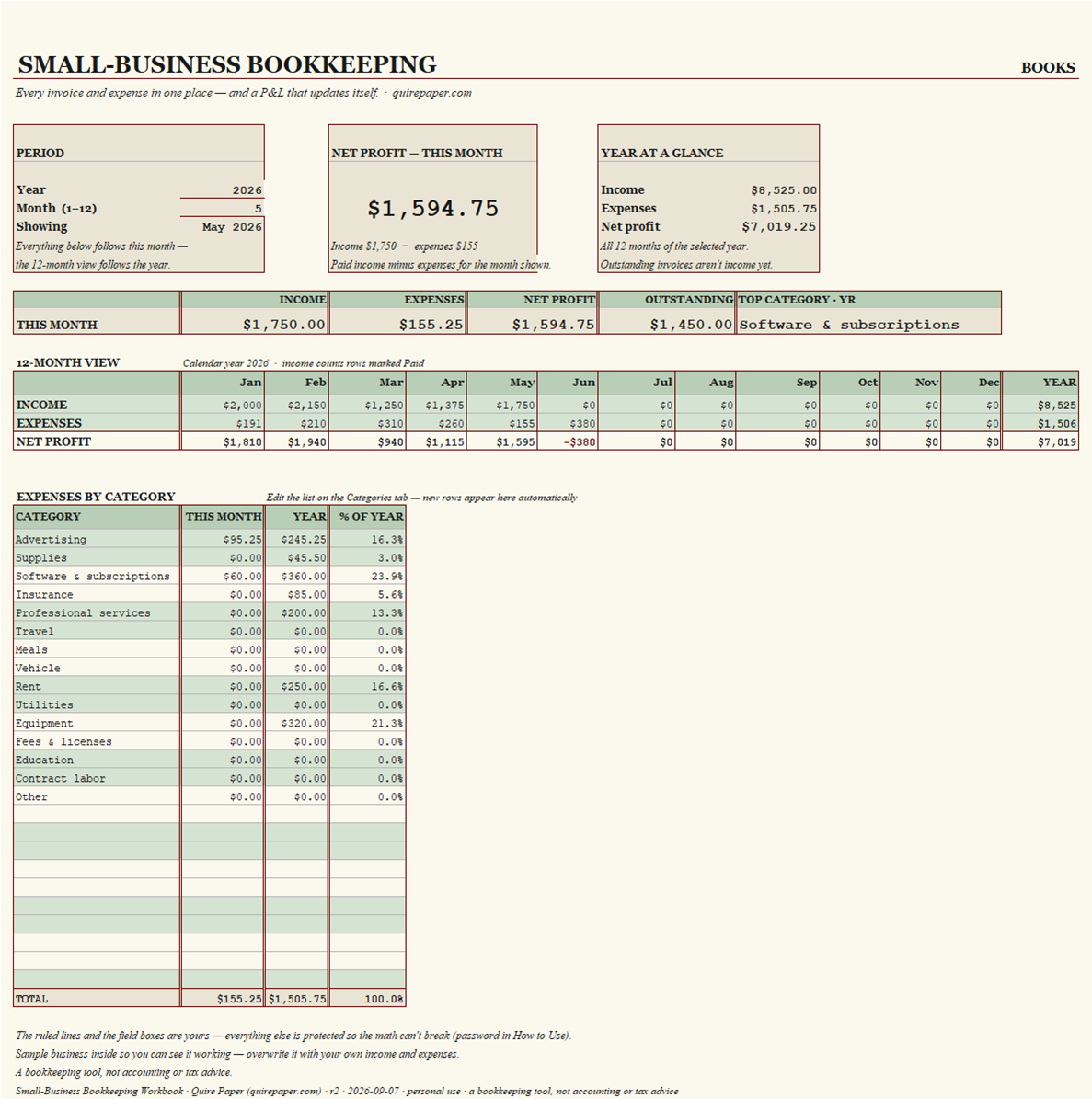
Every invoice and expense in one place — and a P&L that updates itself: an income ledger with invoice status, an expense ledger with category dropdowns, and a month-by-month dashboard with a year at a glance.

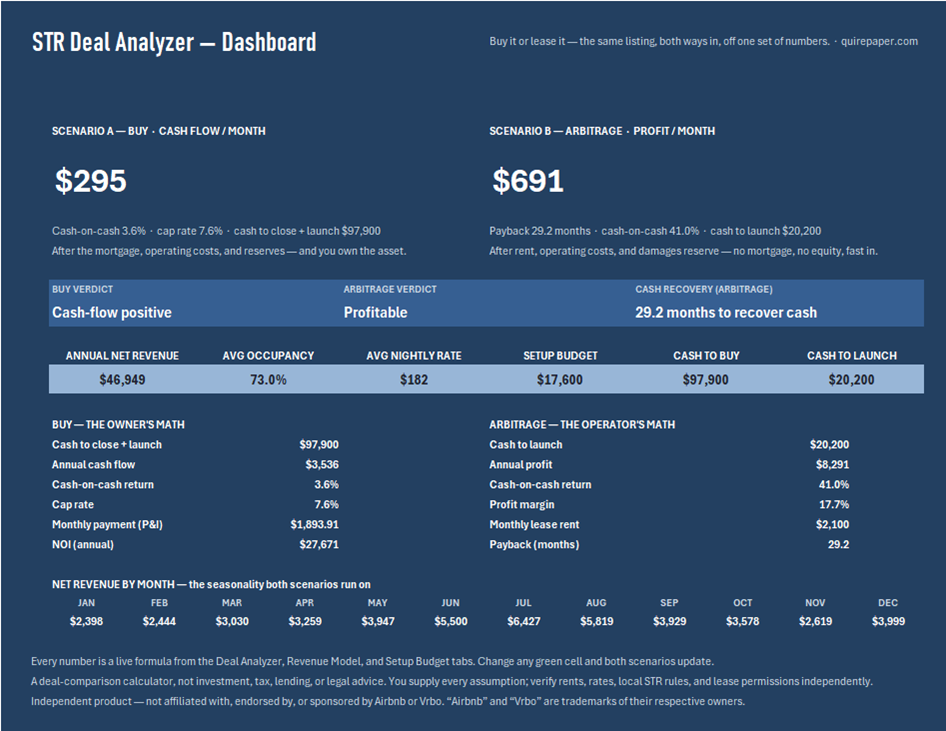
Buy the property, or lease it and host it? One set of honest numbers runs both: a 12-month seasonal revenue model (your occupancy, your rates) and a furnish-to-launch budget feed a BUY analysis (PMT payment, cash flow, cash-on-cash, cap rate) and a RENTAL-ARBITRAGE analysis (margin, payback months) side by side. Five tabs, pure formulas, no macros.

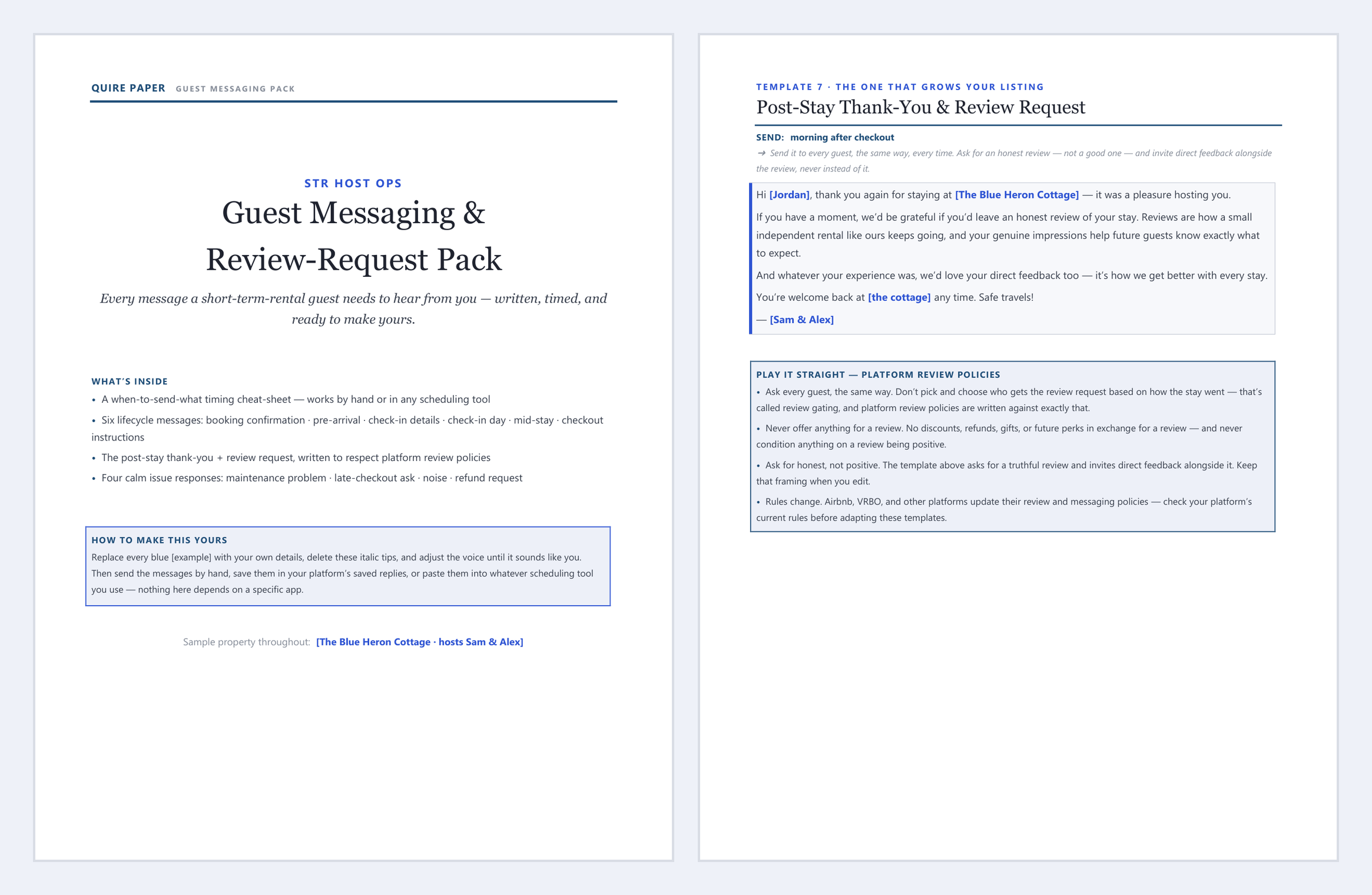
Eleven pre-written guest messages for the whole stay — booking confirmation, pre-arrival, check-in details, mid-stay, checkout, the post-stay review request, and four calm issue responses — plus a when-to-send-what timing cheat-sheet. Replace the blue example text with your details; works by hand, in saved replies, or pasted into any scheduling tool.

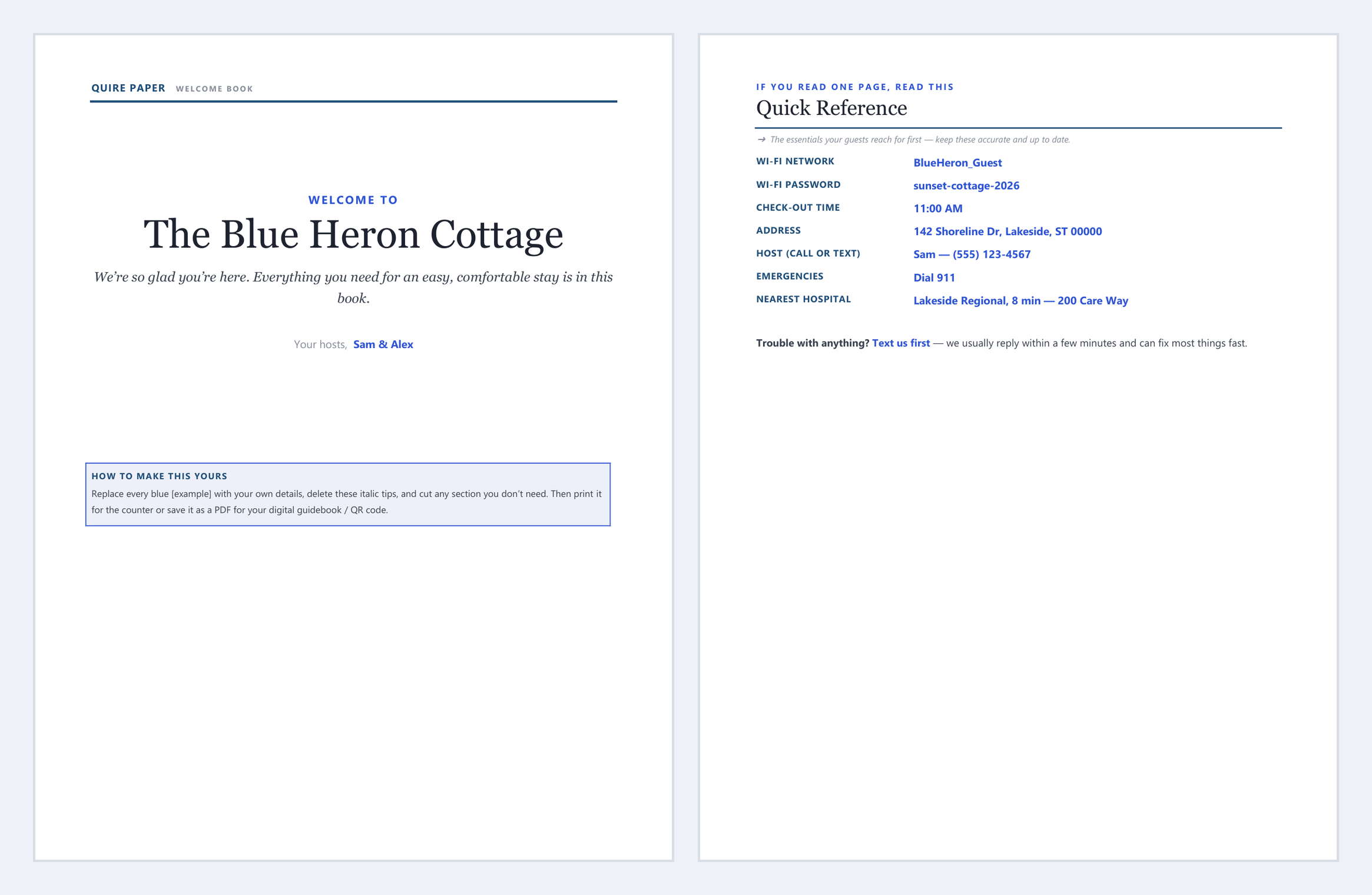
A beautiful, fully editable house manual for your short-term rental: Wi-Fi, check-out, how everything works, house rules, your local favorites, and safety — all in one polished guidebook. Replace the blue example text with your details, delete the tips, print it or save a PDF for a QR-code digital guide. Editable Word template + a filled sample PDF.

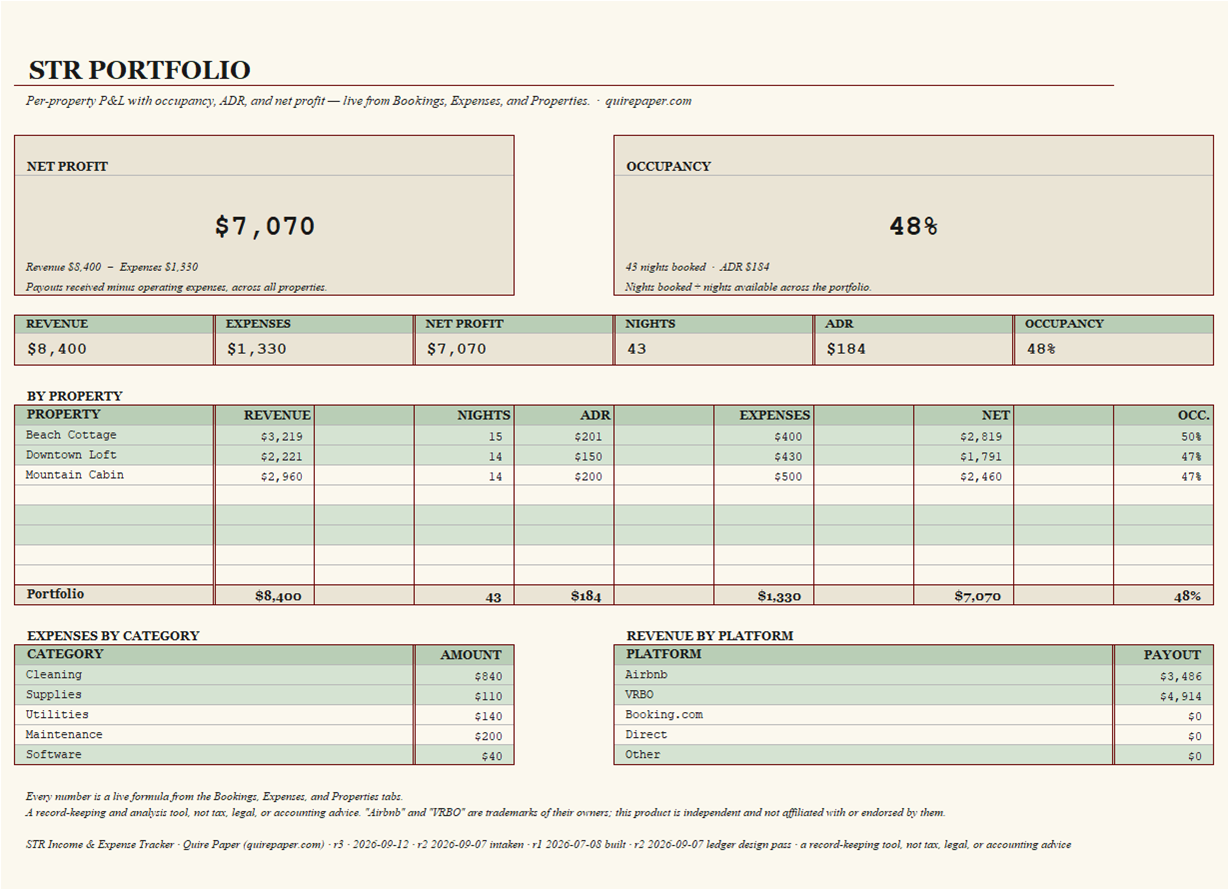
Every booking and expense across your Airbnb & VRBO listings in one workbook — with per-property P&L, occupancy, ADR, cleaning and platform fees, and net profit figured for you. Multi-property, formula-driven, no macros.
Never run short mid-turnover. Set a par level for every supply in every property, log what's on hand, and the sheet computes the reorder quantity, the restock cost, and an OK / Reorder / Out status — with a dashboard that totals your shopping run by category and by property. Two tabs, pure formulas, no macros.

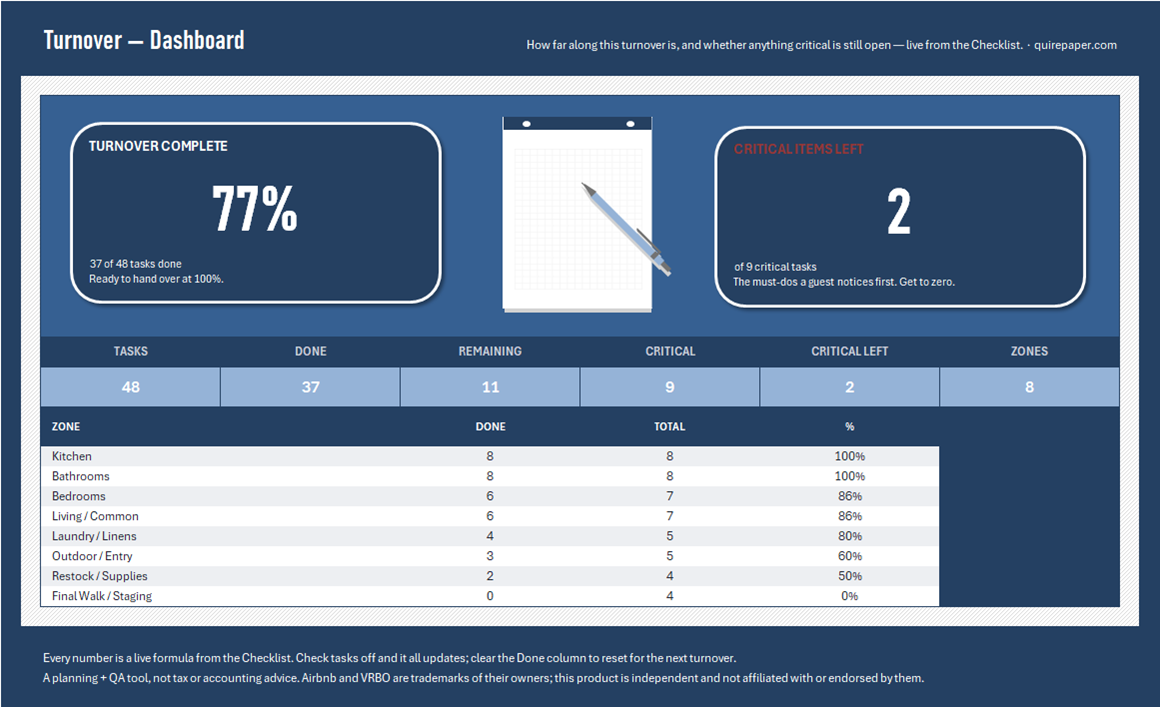
Not a static printout — a trackable turnover QA system. ~48 tasks across 8 zones, each with a critical flag and a done check, plus a live engine that shows your completion %, tasks remaining, and the critical items still open before you hand the property over. Two tabs, pure formulas, no macros.
Every subcontractor's certificate of insurance in one register that watches the expiration dates for you — flagging who's lapsed, who's about to, and who's missing a required policy before they set foot on your site. Type the dates; the workbook tracks the rest.

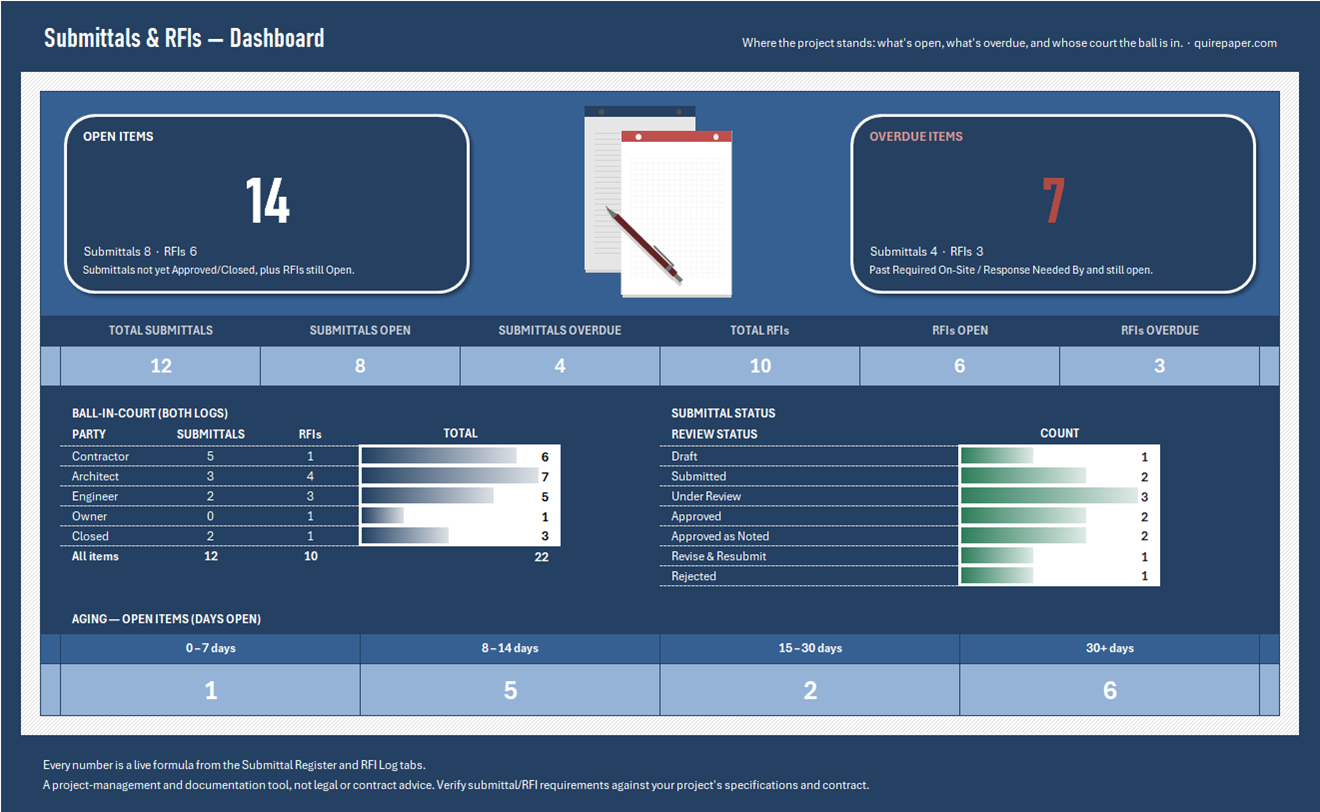
Two logs every project lives by — a submittal register and an RFI log on one dashboard that shows, at a glance, what's open, what's overdue, and whose court the ball is in. Type your entries; the workbook counts the rest.

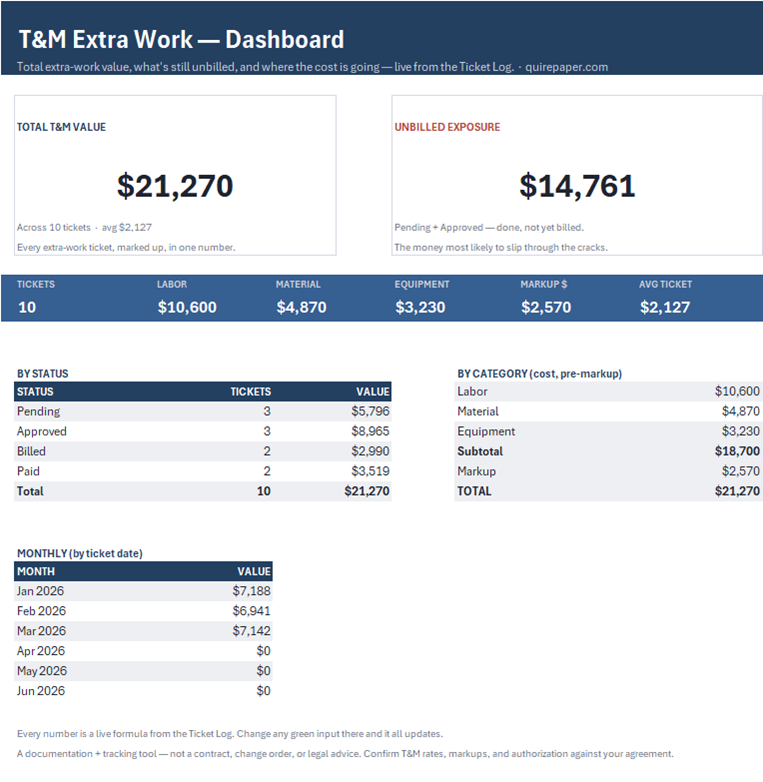
Document every time & material extra: a signable field ticket for labor, material, and equipment (each with its own markup), plus a running log of every ticket and a dashboard that surfaces your UNBILLED EXPOSURE — the approved work that hasn't hit an invoice yet. Four tabs, pure formulas, no macros.
Compare rental applicants side by side on the same lawful criteria — income ratio, credit, rental history, references, background — with a built-in fair-housing & FCRA checklist. It does the income math and keeps the record; you make the decision.

A guided capture kit for loud minds: prompted brain-dump page, a calm four-pile sort, tiny first steps, a bedside night page, and pocket cards. From our Daily Reset line.

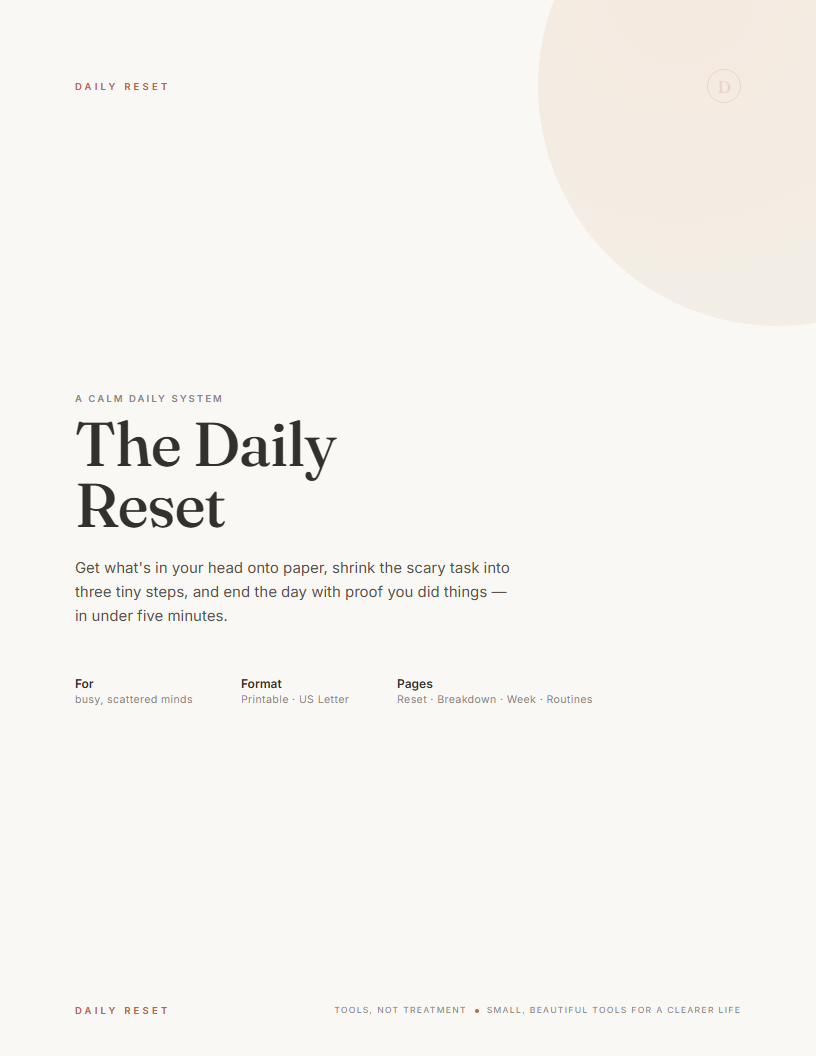
A calm one-page daily planner for busy minds: brain-dump, pick just three, break down the scary task, end the day with proof. From our Daily Reset line.

A calm month-ahead ritual: dump it all, pick just three things, keep one gentle habit, close the month with proof. From our Daily Reset line.

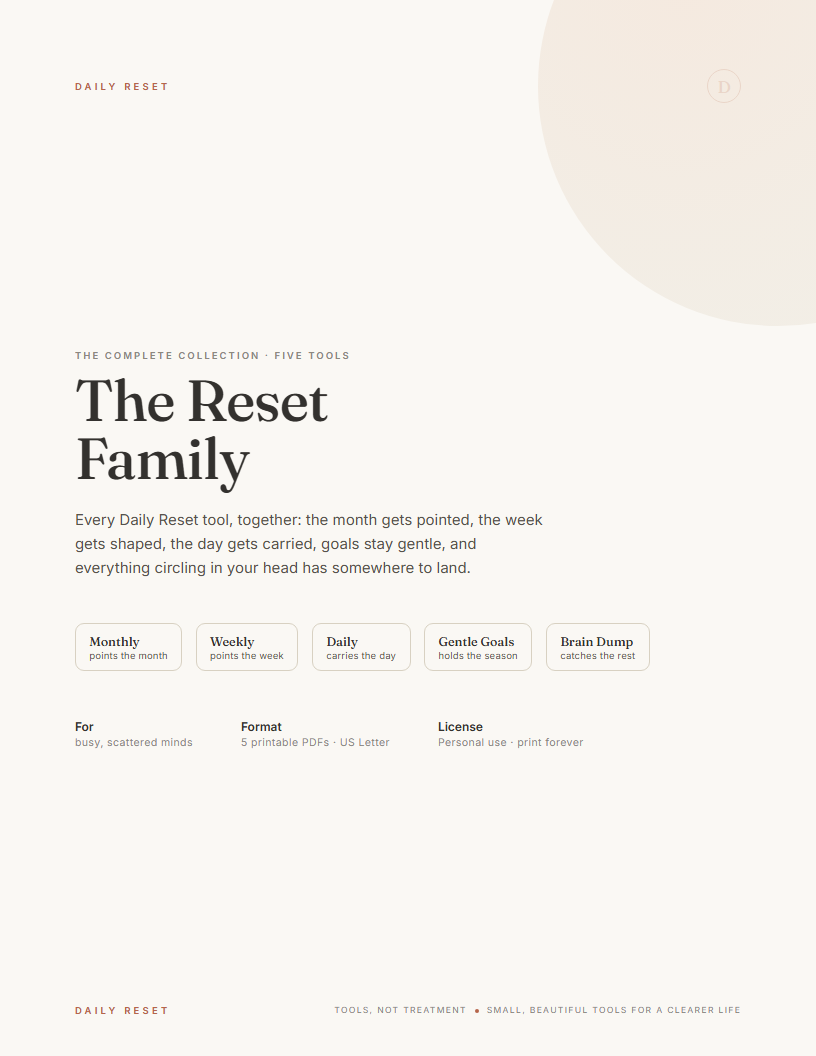
The complete Daily Reset collection — Daily, Weekly, and Monthly Resets, Gentle Goals, and the Brain Dump, with a Start Here guide. $56 separately, $39 together.

A ten-minute Sunday ritual: dump the week, pick three, match heavy work to your good hours, close kindly on Friday. From our Daily Reset line.

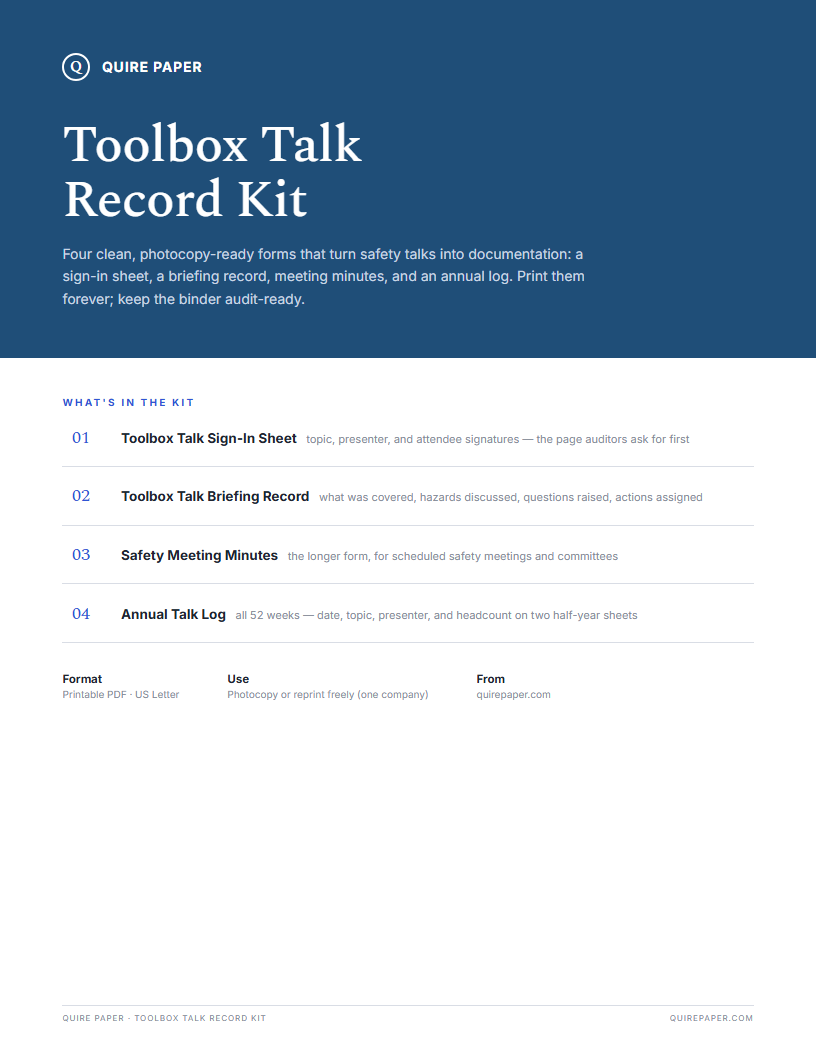
Four photocopy-ready forms that turn safety talks into documentation: sign-in sheet, briefing record, meeting minutes, and a 52-week annual log. Keep the binder audit-ready.

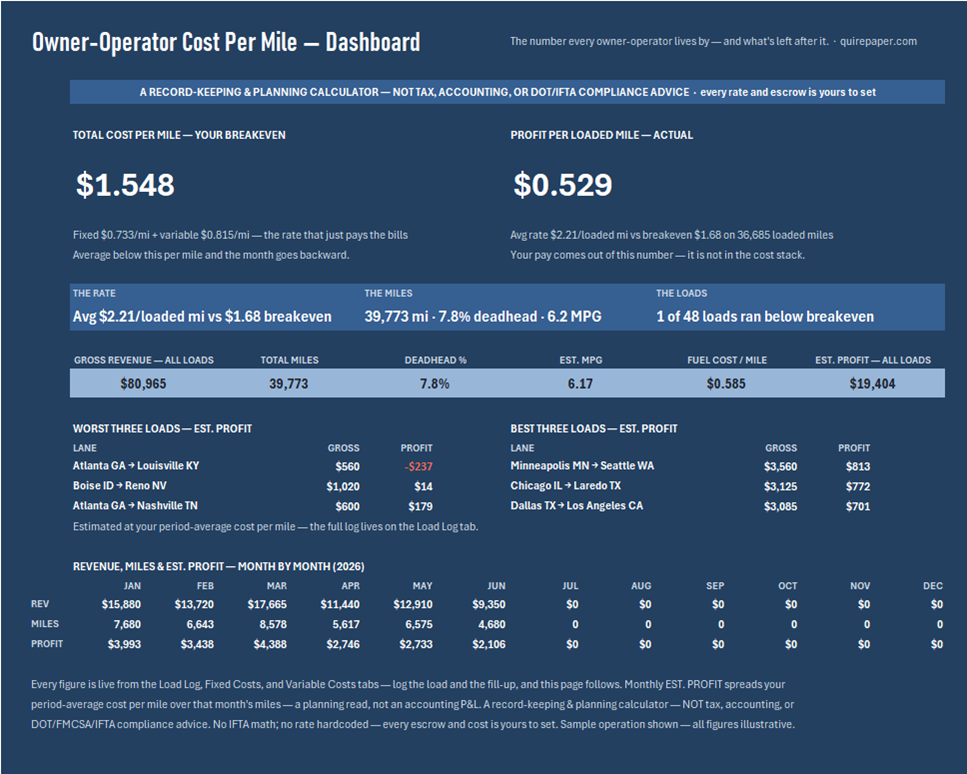
The number every owner-operator lives by, computed instead of guessed: a Load Log (loaded and deadhead miles, gross pay, rate per mile, estimated profit per load), Fixed Costs at YOUR expected monthly miles, a fuel log that turns fill-ups into MPG and fuel cost per mile, and the engine that adds it up — total cost per mile, breakeven per loaded mile, profit per loaded mile. No IFTA math, no compliance claims — every rate and escrow is yours to set.

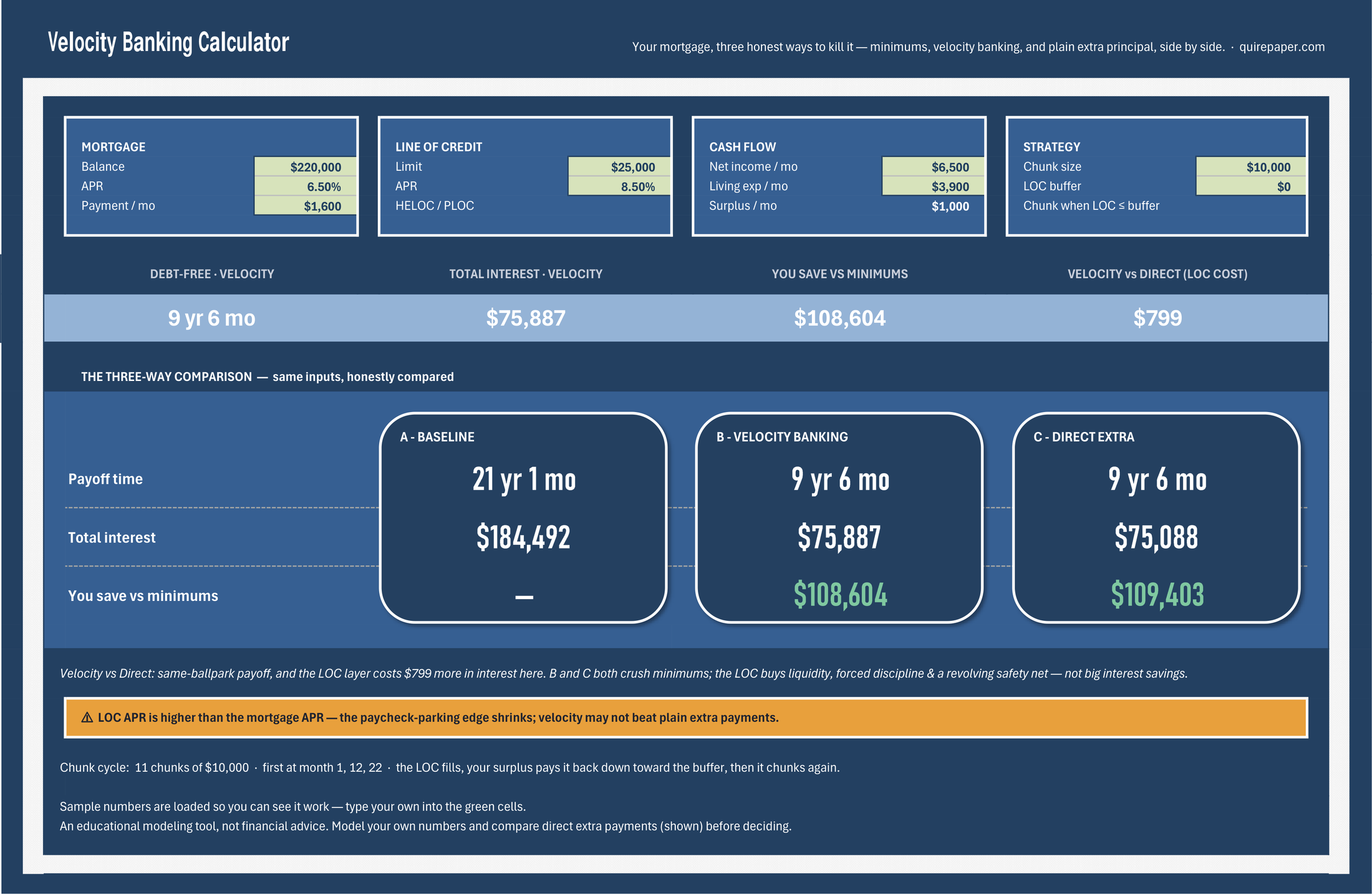
Model the velocity-banking mortgage-payoff strategy with your own numbers — chunk from a line of credit, funnel your cash flow, and watch the payoff. Compared honestly, side by side, against minimum payments and plain extra principal.

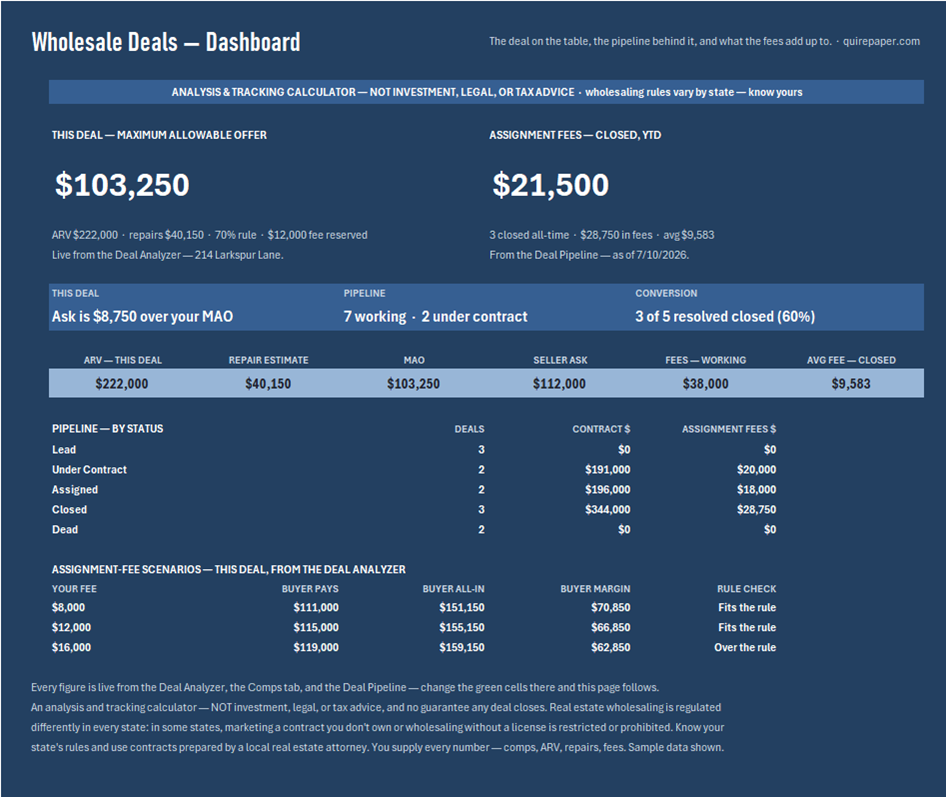
MAO the way it should be figured: your own comps normalized to $/sqft suggest the ARV, a contractor-grade repair quick-estimate feeds the chain, and ARV × your %-rule − repairs − your fee = the most you can offer. Then the deal side: assignment-fee scenarios at three tiers (what the end buyer pays, their margin, whether the rule still holds), a double-close cost check, and a 24-row pipeline from lead to close. A calculator — not legal or investment advice; wholesaling rules vary by state.